A value is a projected representation whose information attention combines according to attention weights to produce an output. In Transformer cross-attention, decoder queries interact with encoder keys and values; relevance scores determine how encoded information contributes to a context vector guiding token generation. section 5.1
Figure 5.1 A simplified schematic of the Transformer architecture. The model consists of an encoder (left) and a decoder (right), each comprising repeated stacks of sublayers, including multihead attention mechanisms, feed-forward neural networks, and postprocessing steps such as residual connections and layer normalization. Positional encodings (depicted as circled crosses) are added to the input embeddings to explicitly represent token order. The diagram emphasizes the cross-attention operation (dashed box labeled “Cross-attention”), in which the decoder’s queries (Q) interact with the encoder’s keys (K) and values (V). During cross-attention, each decoding step computes attention scores to determine the relevance of encoded input representations, producing a context vector that guides token generation. This selective alignment enables the decoder to integrate contextual information from the encoder, improving the accuracy and coherence of the output sequence.
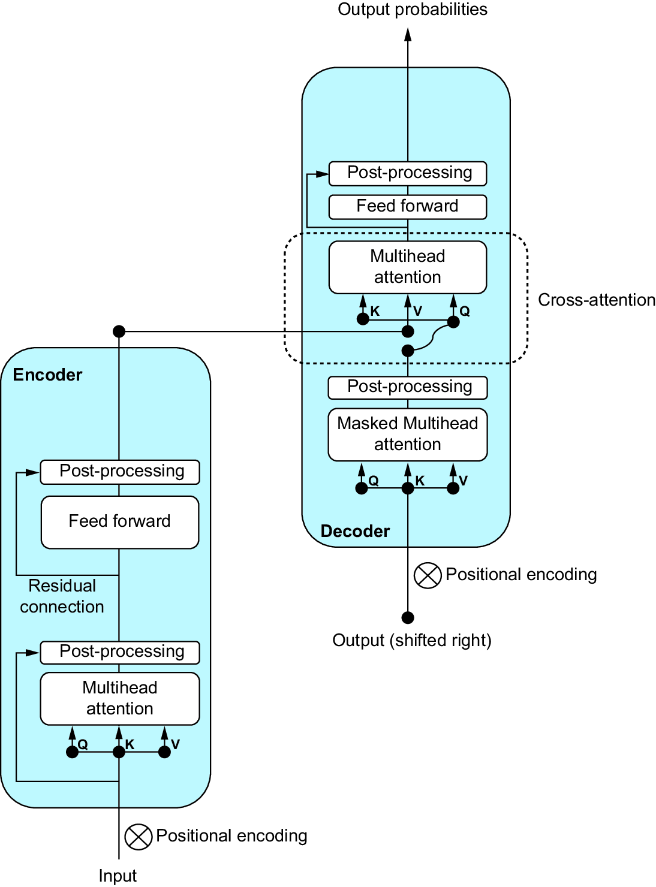
The schematic shows decoder queries interacting with encoder keys and values in cross-attention. section 5.1







