Assumption-based discussion improves collaborative demand forecasting by examining the beliefs and demand drivers behind each forecast instead of debating final numbers first. Participants vote independently, reveal forecasts simultaneously, and then discuss how they interpreted promotions, product launches, marketing budgets, competition, pricing, and other leading indicators. section 16.3.2
Use the discussion to preserve independent judgment and uncover the reasoning behind different forecasts:
- Prepare numbers independently and share them simultaneously before debate. section 16.3.2
- Discuss assumptions and their expected impact on demand rather than averaging final predictions. section 16.3.2
- Ask open questions such as “How did you take this promotion into account?” rather than closed questions that invite a simple yes or no. section 16.3.2
- Let the highest-paid participant speak last to reduce anchoring, social pressure, and groupthink. section 16.3.2
- Include diverse perspectives and align objectives so participants contribute useful information without intentionally skewing the forecast. section 16.4
Why averaging can hide useful information
Suppose colleagues independently forecast between 1,150 and 1,250 units. Averaging produces roughly 1,200 units, but three colleagues may each have identified a different valid reason to increase the baseline. Adding their separate uplift assumptions produces 1,700 units, preserving insights that averaging would erase. section 16.3.2
Figure 16.9 Collaborative forecast based on assumptions
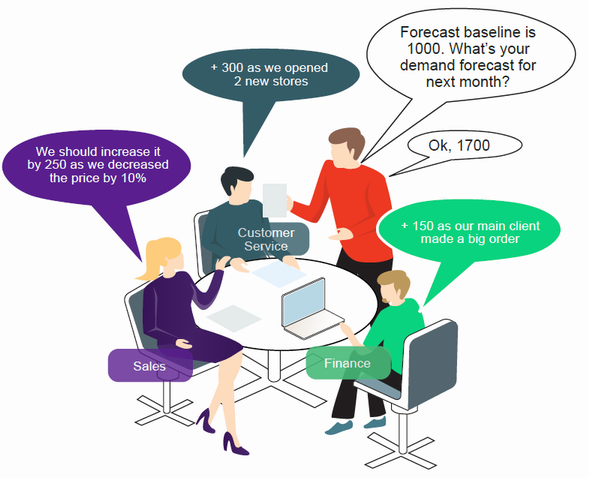
Use the assumption-based collaborative forecast figure to compare a forecast built from explicit demand-driver uplifts with one built by averaging individual predictions. section 16.3.2
