Variation creates a changed candidate from an existing one. In the framework, `mutate()` performs this step; the new artifact also records its parent, preserving its lineage. section 4.1.2
Changing an artifact
A parent artifact can produce a child with `parent.mutate(new_content=rewrite)`. Unlike the toy example that changes an integer, this keeps track of the artifact’s parent. section 4.1.2
Figure 4.2 The same four mechanics, in two vocabularies. Evolution runs down the left column and the framework down the right: variation maps to mutate(), heredity to the parent pointer, selection to the Signal, and time to the search round. Reading across each row is how the evolutionary loop becomes the real primitives, with nothing added but new names.
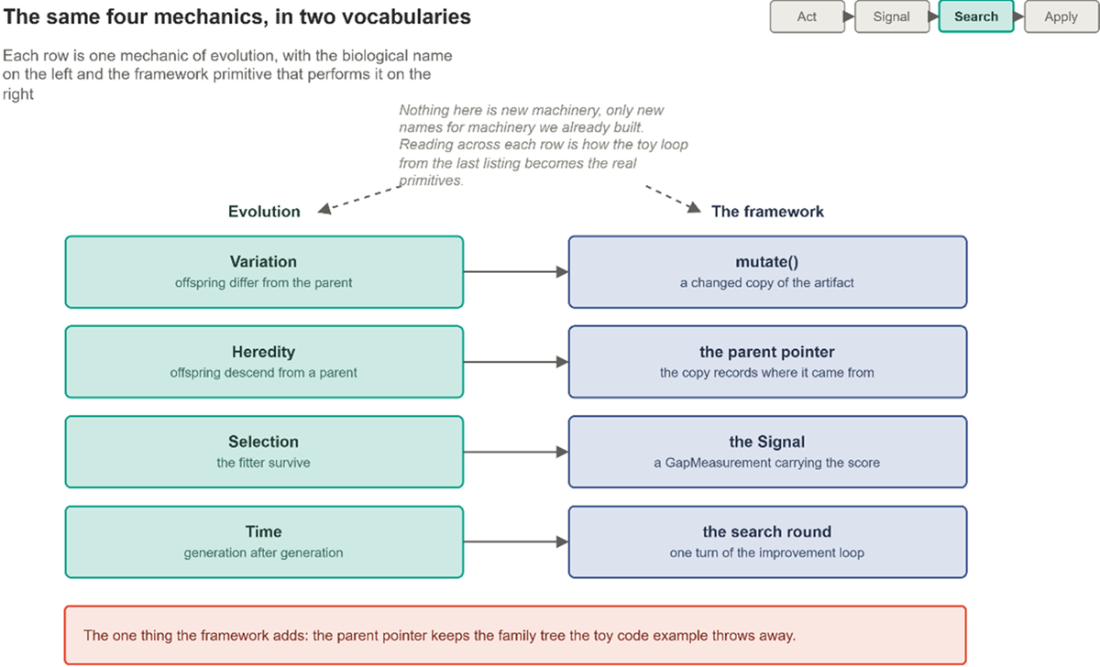
See how variation fits alongside heredity, selection, and time in the evolutionary loop. section 4.1.2