A verifier checks whether an agent’s result satisfies relevant criteria. In a recovery loop, it turns a failure into a concrete signal: after a bounded repair, the agent can check whether the change worked. Verification is limited to conditions the verifier can observe and judge. section 7.3.1
Keep the verifier, acceptance criteria, and protected tests read-only during recovery. A process proposing a repair should not be able to rewrite the evidence used to approve it. The loop should verify each mutation, preserve a rollback point, stop when progress stalls, and hand off failures outside its authority. section 7.3.1
Repairing a tool invocation
A tool call fails because a newer tool version removed an argument. Inside a sandbox, the agent inspects the current contract, revises the invocation, and runs the check again. If the failure instead requires authoritative domain knowledge the system lacks, another retry cannot supply it; the agent should request that knowledge or hand off the task. section 7.3.1
Figure 7.2 The Self-Heal Loop. The agent captures a baseline, diagnoses a failure, checks repair authority, applies a change atomically, verifies it, and either recovers, retries, rolls back, or hands off.
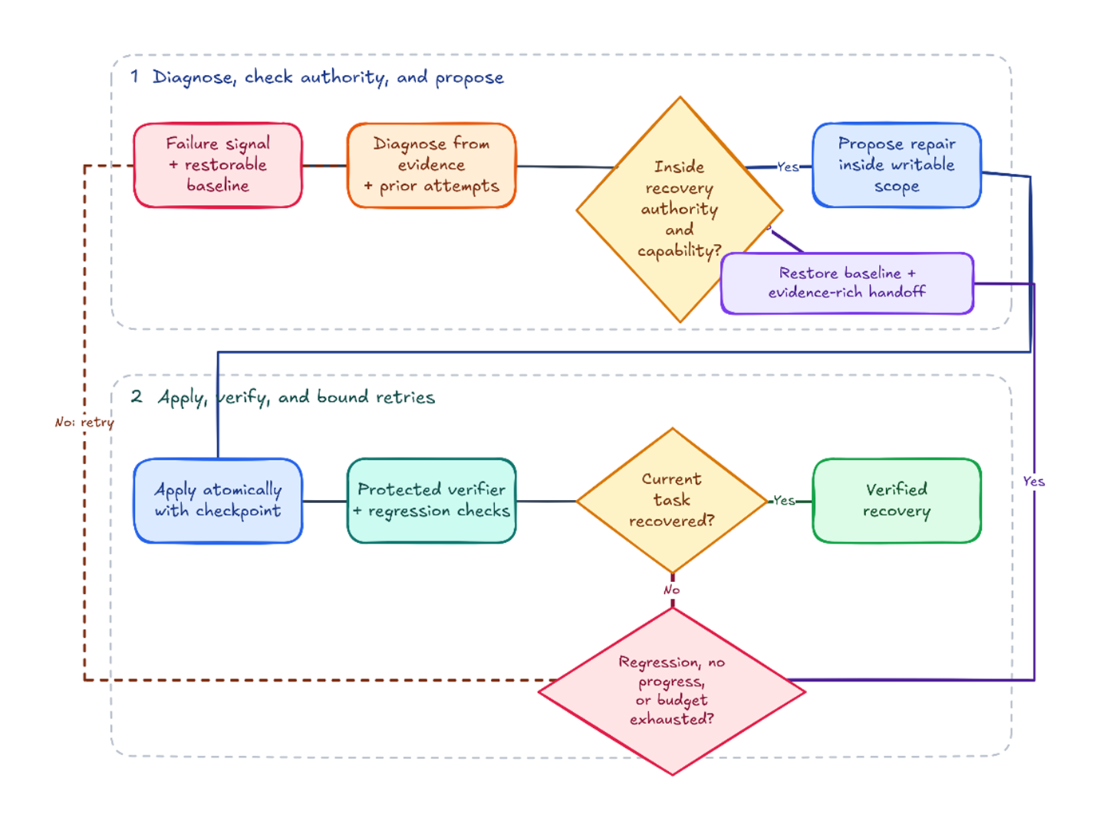
Follow the recovery loop from baseline and authority check through verification, retry, rollback, or handoff. section 7.3.1
Verification is distinct from admission and containment. A sandboxed command’s successful exit does not prove that the intended test ran or that a remote outcome occurred. In a code-repair flow, a surrounding service can rerun applicable verifiers before opening a pull request and refuse publication; even then, correctness is established only within what those checks observe. section 6.5.2
A separate verifier also has a cost. Add one to a reasoning flow when its measured improvement justifies the extra call. Repeated checks and repairs can add latency, token use, and state complexity; agreement among sampled answers is evidence of stability, not proof of truth. section 5.2.5 section 7.3.1








