AI assistance supports development from planning and coding through testing and documentation. Vibe coding is a conversational approach at one end of that spectrum: a developer describes what they want in natural language, and an AI generates code while the developer guides and tests the result. It is especially useful for quick prototypes and creative projects, but it does not replace structured practices for important applications. section 1.12 section 10.0
Simple language does not have to mean a vague request. Describe the desired result, technical constraints, and relevant context. A clear initial prompt helps prevent the tool from choosing an unintended stack or building the wrong thing. section 10.4 section 10.9
Prototype a river-crossing game
Ask Cursor: “Generate full, runnable code for a minimalist Frogger-style game in one file that a user can copy-paste and run immediately.” Specify Python 3.10+, Pygame 2.x, no external assets, the controls, log movement, scoring, and code-quality expectations. The resulting game ran on the first try, but playing it revealed overlapping logs that needed a follow-up change. section 10.4 section 10.7 section 10.8
Revise through conversation
Describe what you observed: “Some of the logs run into each other and overlap. Please fix it so they are spaced apart, move at the same speed, and don’t overlap.” Cursor proposed consistent speeds within each lane, spacing, and revised respawning. Inspect the proposed changes and run the game again rather than relying on the tool’s claim that the issue is fixed. section 10.8 section 6.3
Figure 10.10 There is a diff interface that comes up in Cursor. You can accept individual changes or accept the entire file if you like.
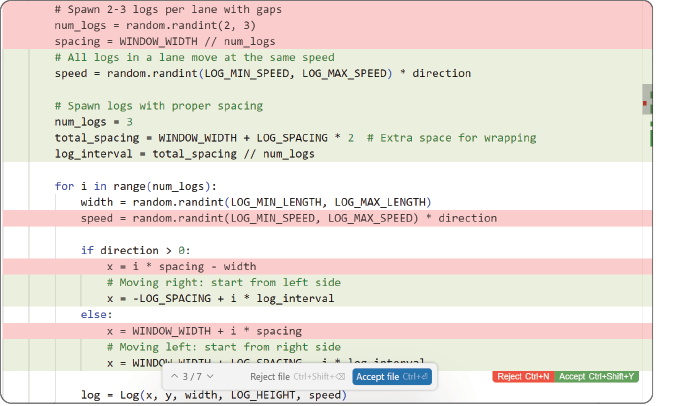
Cursor’s diff interface lets you inspect and accept individual changes or an entire file. section 10.8
Keep the developer in control:
- Supply relevant files and documentation, rather than overwhelming the agent with unrelated context. section 10.9
- Review diffs, check how changes fit the architecture, and test after each implementation stage to catch errors early. section 6.3
- Treat suggestions as options, not decisions. Choose a stack and design that fit the project instead of automatically accepting a more elaborate recommendation. section 4.6
- Review generated documentation for accuracy and add a human touch. For production or security-sensitive systems, retain structured development and thorough testing. section 1.8.5 section 10.9
