What happens when researchers, companies, and ordinary people can share information across one connected space? The World Wide Web is a global hypertext document system built on the Internet, linking people to content, products, services, research, and communities. section 3.1 section 1.3.3
Tim Berners-Lee proposed the Web in 1989 to help researchers at CERN share results, techniques, and practices without constantly exchanging email. As access spread, the Web became a rapidly expanding public environment for companies, movements, organizations, hobbies, and groups. section 3.1 section 1.3.3
The Web also became a foundation for data-driven services. Google’s 1998 search service offered free access to the Web while using data created by its users, then built its business around advertising. This connected everyday searching with commercial targeting and raised questions about how online activity should be governed. section 1.3.3 section 3.1
The Web matters because it combines access, participation, and commercial incentives:
- It lets people search across an enormous and diverse body of online content. section 1.3.3
- It turns ordinary activity into data that companies can analyze and use for advertising or other commercial purposes. section 1.3.3
- It leaves governments and communities negotiating how online behavior, commerce, and communication should be governed. section 3.1
Figure 1.1 Global search engine market share. Source: Reliablesoft (https://www.reliablesoft.net/top-10-search-engines-in-the-world/)
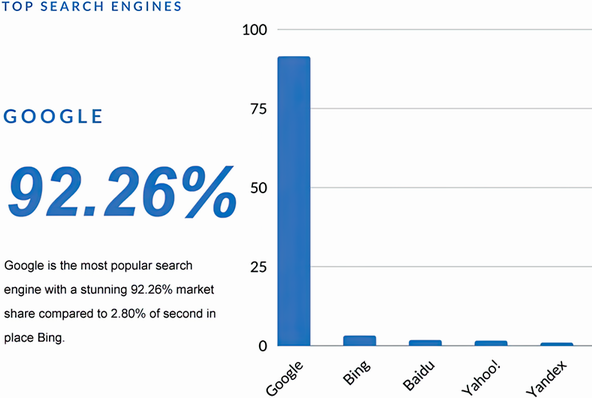
Compare the global market share of major search engines and see how strongly Google dominated search in 2021. section 1.3.3
