liveBook · Manning

Model weight

As explained in Grokking Bayes

A weight is a learnable coefficient that scales a connection or input in a neural-network transformation.

In a neural network, a weight is the coefficient assigned to an edge between layers. It scales the input as part of a linear transformation, helping determine the network’s predictions. Weights are learned parameters; the transformation also includes a separate bias term. section 10.1

Figure 10.2 The architecture of an example neural network with two hidden layers of size 6 and 4.
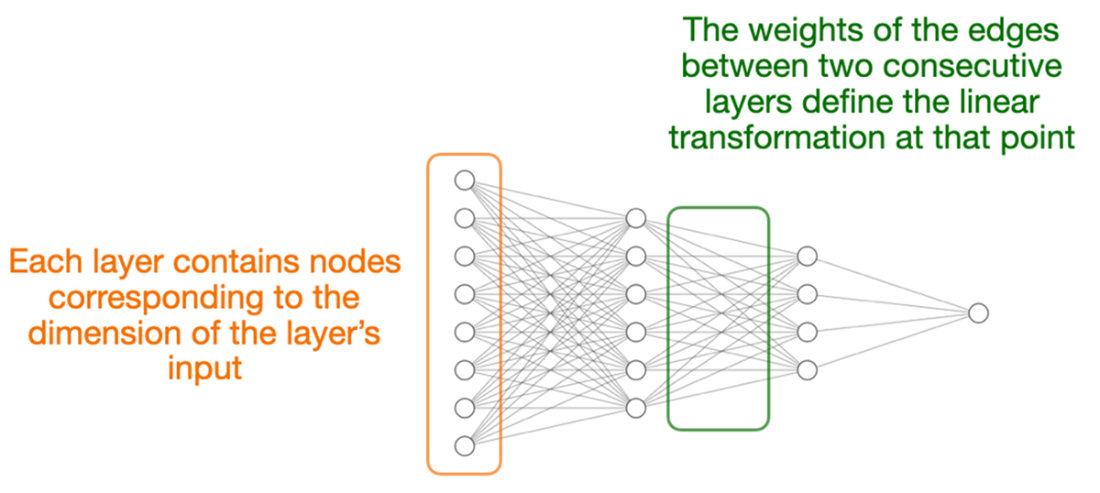
This network diagram shows how edges connect nodes across layers, illustrating where weights act. section 10.1


How Grokking Bayes covers it

How deep it goes
Defines each weight as an edge coefficient in a linear transformation and distinguishes it from the bias term.
Examples
Uses a network with two hidden layers of six and four nodes to illustrate weighted edges.
What you can do after
Understand how edge coefficients help determine a neural network’s input-to-output mapping.
How it connects
Connects weights to neural networks, linear transformations, biases, and loss minimization.

Also explained in

Compare how 8 books explain model weight →

Related concepts

This explainer was generated by Manning's knowledge graph from the text of Grokking Bayes. The section links point to the parts of the book it draws on.





