A temporary approach that restores or preserves functionality without correcting the underlying defect.
A workaround restores customer-facing functionality quickly while the underlying defect remains unresolved. Stabilize service first; investigate the cause afterward. section 11.3.1
Use the fastest reversible action that returns the application to a working state:
Revert a recent code update and redeploy the previously working version. section 11.3.1
Disable a new or updated feature that is not urgently needed. section 11.3.1
Temporarily take a nonessential microservice out of commission. section 11.3.1
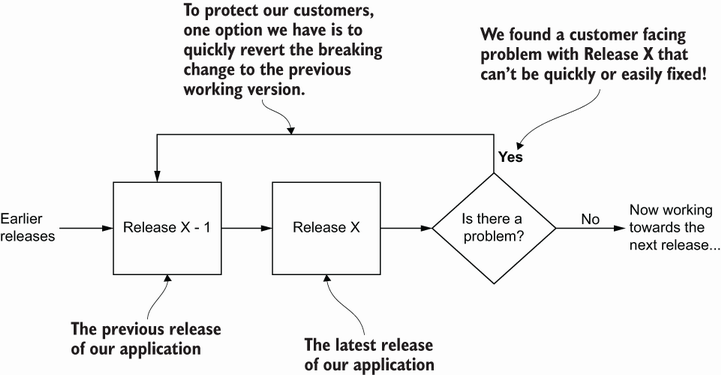
Figure 11.10 Mitigating the risk to our customer after a problem is found by immediately rolling back to a previous working version
Shows how rolling back to a previous working version immediately reduces customer risk. section 11.3.1
How Bootstrapping Microservices, Second Edition: With Docker, Kubernetes, GitHub Actions, and Terraform covers it
How deep it goes
Provides several operational mitigation choices but defers root-cause analysis and the long-term correction.
Examples
Uses code rollback, feature disabling, and temporarily removing a nonessential microservice as mitigation examples.
What you can do after
Operate/configure a production system to restore service quickly through rollback, feature disabling, or service isolation.
How it connects
Connects rollback, feature flags, microservices, redeployment, production incidents, and debugging.
countermeasurecontrasts with · A countermeasure is an action or control intended to address a problem or threat by reducing its causes, effects, or likelihood.
bugproduced by · A software bug is a defect in software or a related system component that causes behavior to differ from what is intended or expected.
big ball of mud architectureproduces · Big ball of mud architecture is a software architecture with tangled dependencies, blurred boundaries, and weak structure that make it difficult to understand, maintain, or change.
business problemaddresses · A business problem is an organizational need, objective, constraint, or challenge that a proposed solution is intended to address.
This explainer was generated by Manning's knowledge graph from the text of Bootstrapping Microservices, Second Edition: With Docker, Kubernetes, GitHub Actions, and Terraform. The section links point to the parts of the book it draws on.