The Z gate is a single-qubit Pauli operation that leaves |0⟩ unchanged and multiplies |1⟩ by −1, changing relative phase without flipping the basis state. section 5.1.1
Distinguishing X from Z
Prepare |0⟩ and apply the unknown gate. Measuring 0 identifies Z because Z leaves |0⟩ unchanged; measuring 1 identifies X because X maps |0⟩ to |1⟩. section 5.1.1
Controlled-Z also demonstrates phase kickback. With a control qubit in |+⟩ and a target in a Z eigenstate, the target remains unchanged while the control becomes |+⟩ for target |0⟩ or |−⟩ for target |1⟩. Measuring the control therefore reveals the eigenvalue: +1 or −1. section 5.3.1
Figure 5.5 To use the phase kickback trick for phase estimation, we need a control qubit in a superposition state (the \(\ket{+}\) state is commonly used) and a target register of qubits in the state that is an eigenvector of the unitary we’re exploring. When we apply the controlled variant of this unitary, the target register remains unchanged, but the control qubit acquires a relative phase on the basis state \(\ket{1}\). This relative phase can be analyzed to extract informa-tion about the eigenphase that corresponds to the eigenvector.
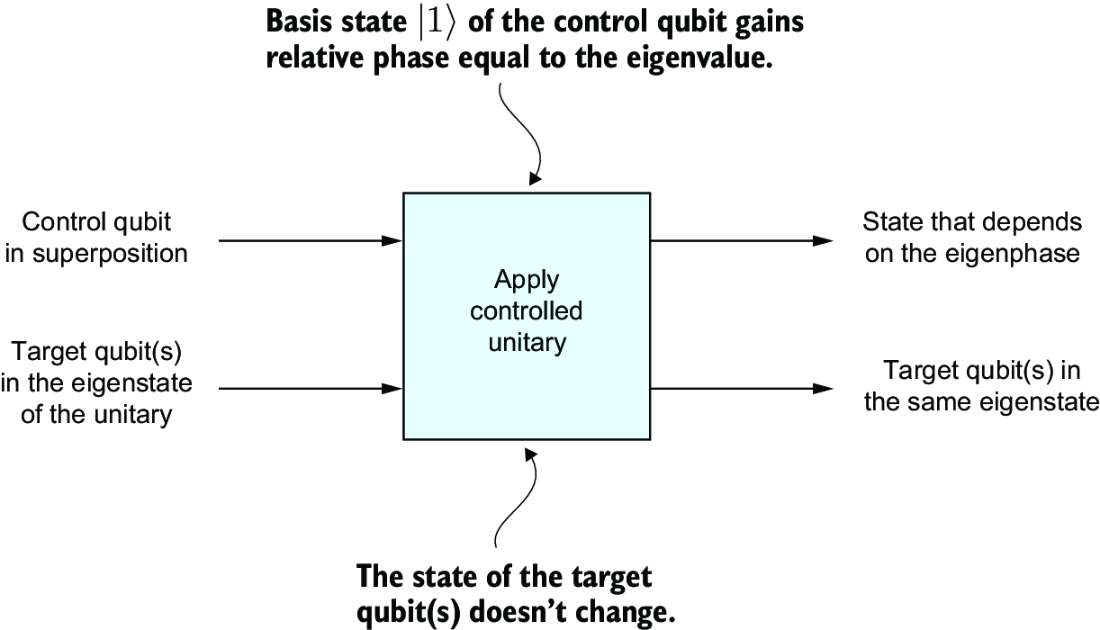
Use the phase-kickback circuit diagram to trace how a controlled unitary transfers an eigenphase to the control qubit while preserving the target eigenvector. section 5.3.1

