A zero-knowledge proof lets a prover demonstrate knowledge of secret information—a witness—without revealing the witness itself. Peggy might prove to Victor that she knows x in Y = g^x, while keeping x private. A useful proof must be complete, so a knowledgeable prover can succeed; sound, so someone without the witness cannot; and zero-knowledge, so the verifier learns nothing about the witness. section 7.2 section 7.2.1
The Schnorr identification protocol builds the idea from a tempting but unsafe first attempt:
- Hide the witness with fresh randomness: compute s = k + x. This appears to conceal x, but revealing k lets Victor recover x as s − k. section 7.2.1
- Hide the randomness in the exponent instead: compute R = g^k. Peggy sends a hidden value s and R; Victor checks whether g^s equals Y × R. section 7.2.1
- Keep the exchange interactive when Victor supplies a challenge. Interactivity adds messages, requires both participants to be online, and can introduce delays. section 7.2.2
- Apply the Fiat–Shamir transformation to replace Victor’s challenge with a hash of the transcript. Including a message turns the resulting non-interactive proof into a cryptographic commitment to that message: a Schnorr signature. section 7.2.2
From website ownership to private computation
Before receiving a certificate, a website must prove to a trusted authority that it controls its domain. The authority signs the website’s public key, and browsers verify that signature when connecting securely. Broader zero-knowledge proofs can hide selected inputs or outputs while proving that a program executed correctly—for example, proving that a Sudoku has a solution without revealing the solution. In cryptocurrencies, they can protect transaction details or compress blockchain history into a small proof. section 7.1.3 section 12.3.4 section 15.3 section 12.3.3
Figure 15.11 General-purpose ZKPs allow a prover to convince a verifier about the integrity of an execution trace (the inputs of a program and the outputs obtained after its execution) while hiding some of the inputs or outputs involved in the computation. An example of this is a prover trying to prove that a sudoku can be solved.
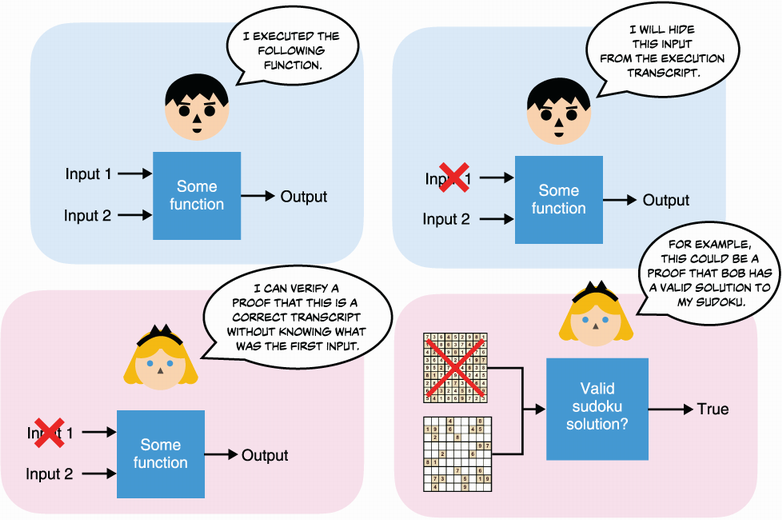
Use the execution-trace diagram to see how a general-purpose proof establishes program integrity while hiding selected inputs or outputs. section 15.3


