Zero-shot prompting gives a model task instructions without examples, relying on its pretraining. It is a flexible, low-token baseline for tasks that align with the model’s training distribution. section 7.2
Start with zero-shot prompting when:
- The task is familiar and the model’s training data is likely to cover it. section 7.2
- You want to avoid the token cost of including examples. section 7.2
- You need a baseline to evaluate before adding examples. section 7.2
Check whether outputs are consistent enough and fit the task’s domain. If proprietary categories, organization-specific conventions, or specialized knowledge lead to inconsistent results, add few-shot examples to address the gap. section 7.2
Common zero-shot tasks
Standard summarization, straightforward sentiment analysis, common format conversions, and general knowledge questions can work reliably without examples. section 7.2
Figure 7.2 Zero-shot to few-shot decision path. Start with zero-shot prompting, evaluate consistency and domain fit, then add few-shot examples when outputs require stronger format control, domain-specific labeling, or edge case handling.
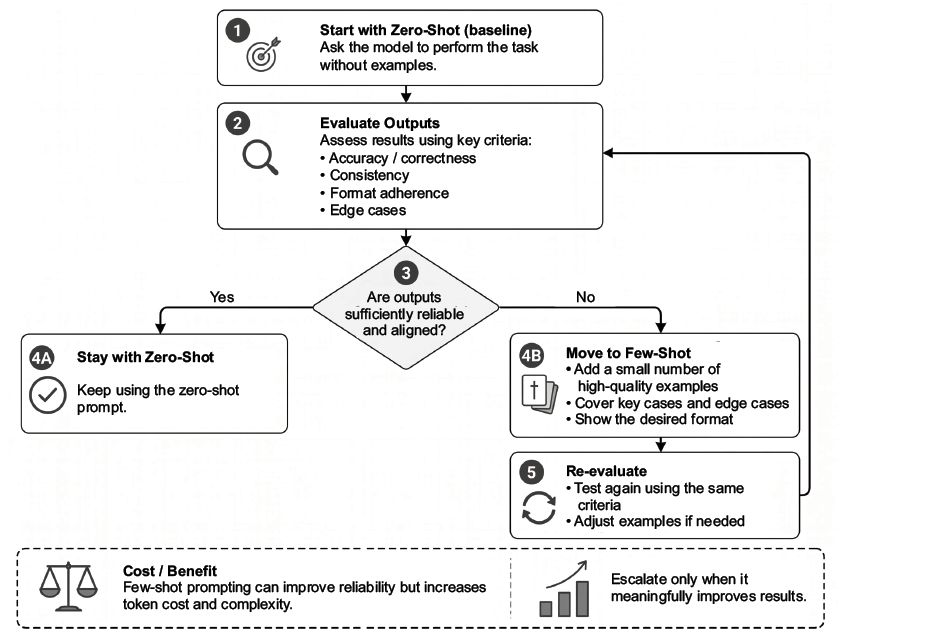
Use the decision path to start with zero-shot prompting, check consistency and domain fit, and add examples when stronger format control, domain-specific labels, or edge-case handling is needed. section 7.2








