liveBook · Manning

Zero-shot prompting

As explained in Time Series Forecasting Using Foundation Models

Zero-shot prompting is prompting a model to perform a task without providing task-specific examples in the prompt.

Zero-shot prompting asks an LLM to perform a task using only a natural-language question or instruction, without task-specific examples. For forecasting, it reframes numerical prediction as question answering: provide past values and ask for the next value. section 8.1.2

A practical zero-shot forecasting prompt should:

  • State the numerical input clearly. section 8.1.2
  • Specify the requested operation, such as forecasting the next value. section 8.1.2
  • Expect free-form output and add extraction logic when numerical values are required. section 8.1.2

Forecasting prompt

The past values are: 10, 15, 21, 26, 32, 28. What will be the next value? A possible response is: The next value will be 35. section 8.1.2

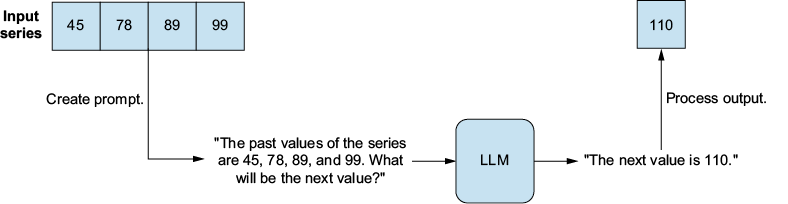
Figure 8.1 General steps of forecasting with LLMs
A black and white image of a square with a square in the middle

Description automatically generated

Use the workflow diagram to connect numerical forecasting inputs with their natural-language LLM prompt and generated response. section 8.1.2


How Time Series Forecasting Using Foundation Models covers it

How deep it goes
Defines the prompt pattern and shows one forecasting example, but defers output-format control to few-shot prompting.
Examples
Uses past values 10, 15, 21, 26, 32, 28 and asks for the next value, with 35 as a possible answer.
What it assumes
Assumes numerical forecasting inputs and teaches how to express them as a natural-language request.
What you can do after
Apply it via an LLM to frame forecasting requests, then extract numerical values from free-form answers.
How it connects
Connects zero-shot prompting to large language models, forecasting, few-shot prompting, and chain-of-thought prompting.

Also explained in

Compare how 9 books explain zero-shot prompting →

Related concepts

This explainer was generated by Manning's knowledge graph from the text of Time Series Forecasting Using Foundation Models. The section links point to the parts of the book it draws on.






