A multi-agent system can reuse a remote agent instead of rebuilding its capabilities. Agent2Agent (A2A) is an open protocol for discovering and communicating with agents, including agents built with different frameworks. It standardizes communication rather than the logic that performs a task. section 1.5 section 10.1.2
Reuse a remote preprocessing agent
A team’s LangGraph agent already handles a data-preprocessing step. An A2A client can discover the agent through its server, send it the preprocessing task, and use the returned result without implementing a separate custom API for that agent. section 10.0 section 10.1.2
A2A uses a client-server architecture over HTTP. A client is an agent or application that sends tasks; a server exposes remote agents. Unlike an in-process subagent, a remote A2A agent executes in an external system or process. section 10.1.2 section 10.5
A client typically makes two exchanges with a server:
- Discover agents by requesting their AgentCards with an HTTP GET to the server’s well-known URI. An AgentCard describes an agent’s capabilities and reachable URI. section 10.1.2
- Send a task for a remote agent to perform. The server returns a result or error; A2A standardizes these communications using JSON-RPC. For long-running tasks, servers can support streaming updates or completion notifications. section 10.1.2
Figure 10.4 The sequence of interactions for A2A clients to send tasks to A2A servers for their agents to perform
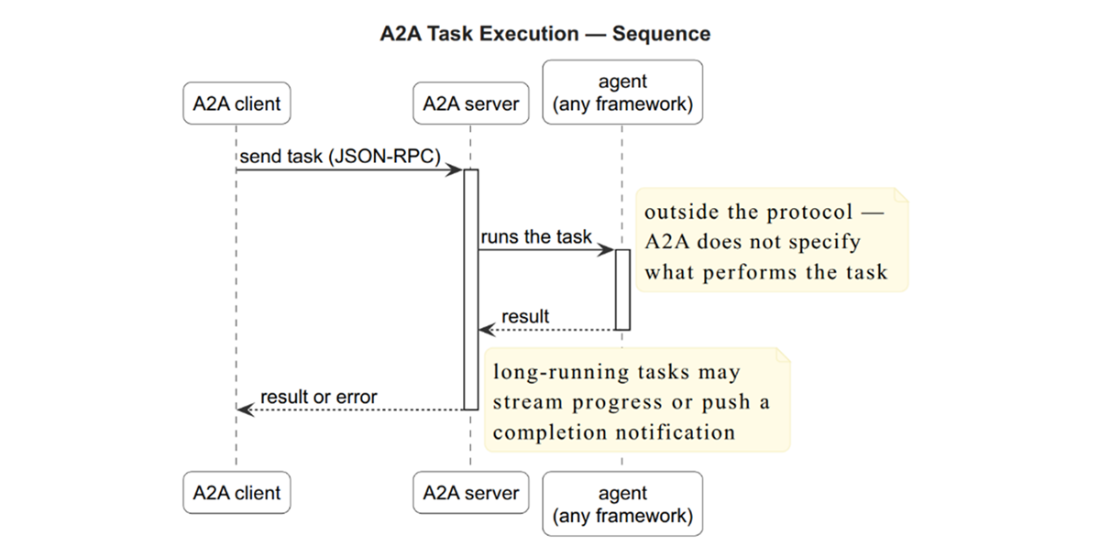
Trace the client-server exchanges involved in remote task execution. section 10.1.2
An LLM agent can participate on both sides. A client integration can represent remote agents with A2AAgentSpec and dispatch them through UseA2AAgentTool. To expose an LLMAgent to other clients, LLMAgentA2AExecutor wraps it as an A2A AgentExecutor; application code hosts the executor in a server. section 10.0 section 10.5
A basic integration need not implement every protocol capability. In the described implementation, UseA2AAgentTool blocks until remote execution finishes, and LLMAgentA2AExecutor does not handle streaming. The client supports the input-required flow, but the server does not; neither side uses context_id for multi-turn context sharing. Security and multi-tenancy require further consideration. section 10.4.2



