liveBook · Manning

Abstraction & Reasoning Corpus for Artificial General Intelligence

As explained in Deep Learning with R, Third Edition

ARC-AGI-1 is the original version of the ARC-AGI benchmark, consisting of abstract reasoning tasks intended to test fluid intelligence.

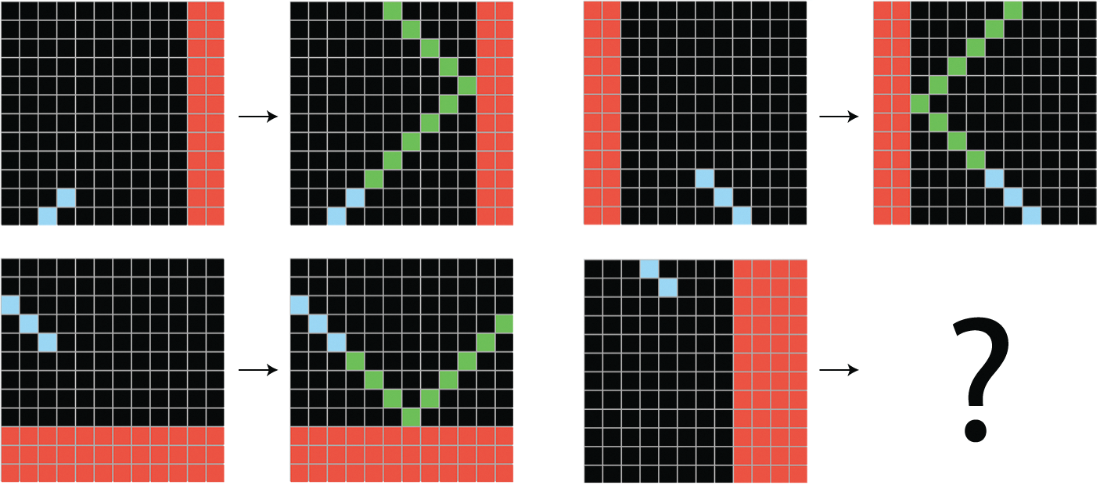
ARC-AGI-1 is a benchmark for fluid intelligence and abstract reasoning. Each task provides three or four input–output grid examples, followed by a new input whose output must be constructed. The task-specific rule is intended to be discovered on the fly rather than recalled from training. section 19.3.4

A typical ARC-AGI task

Study several paired grids, infer the transformation connecting each input to its output, then apply that transformation to an unseen grid. You receive three attempts before moving to the next task, so success depends on identifying the underlying logic rather than memorizing a familiar strategy. section 19.3.4

ARC-AGI controls for prior knowledge through core knowledge priors and tests only tasks that were not previously seen. Its resistance to memorization makes it a demanding test of generalization and on-the-fly recombination; scaling language models alone produced only limited progress on the 2019 benchmark. section 19.3.4 section 19.3.5

Figure 19.9 An ARC-AGI task: the nature of the task is demonstrated by a couple of input–output pair examples. Provided with a new input, you must construct the corresponding output.
figure

Use the task figure to inspect how paired grids demonstrate a rule before a new grid must be solved. section 19.3.4


How Deep Learning with R, Third Edition covers it

How deep it goes
Defines the task format and rationale, but stops short of specifying individual grid transformations or solving algorithms.
Examples
Uses paired input–output grids, an unseen input grid, three attempts, and Figure 19.9 as its concrete task illustration.
What it assumes
Assumes core knowledge priors as a common starting point while demonstrating why solving requires more than prior task exposure.
What you can do after
Evaluate reasoning systems by comparing their ability to infer novel grid transformations rather than memorize known strategies.
How it connects
Connects abstract reasoning with fluid intelligence, generalization, core knowledge priors, IQ tests, and memorization-resistant evaluation.

Also explained in

Compare how 3 books explain Abstraction & Reasoning Corpus for Artificial General Intelligence →

Related concepts

This explainer was generated by Manning's knowledge graph from the text of Deep Learning with R, Third Edition. The section links point to the parts of the book it draws on.
