A channel is one image-data plane describing a feature at each spatial location. RGB images commonly use red, green, and blue channels, each with the same width and height. section 3.1 section 3.8
In a convolutional layer:
- The input has Cin channels; each filter spans those input channels. section 3.2.1
- Each of Cout filters produces one output channel. section 3.4.1
Three input channels, two output channels
A Conv2d layer with Cin = 3 and Cout = 2 applies two filters to the three-channel input and stacks the results into a two-channel output. Padding can preserve the input’s spatial dimensions. section 3.4.2
Figure 3.3 Color images are represented by three sub-images of the same size, called channels. Each channel represents a different concept, the most common being red, green, and blue (RGB). In general, every channel represents a different kind of feature at different locations.
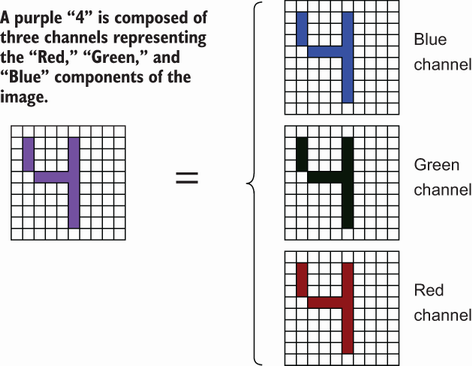
See how an RGB image is represented as three same-sized channel planes. section 3.1