liveBook · Manning

Activation function

As explained in Applied Reinforcement Learning

A function that transforms a neural network unit's pre-activation value, typically introducing nonlinearity.

A neuron applies an activation function after its weighted sum and bias. By introducing nonlinearity, activations let deep networks model complex relationships; without them, stacked layers collapse into one linear transformation. Deep reinforcement learning networks commonly use ReLU in hidden layers and linear outputs for Q-values. section 8.2

Figure 8.5 The building block of deep networks: neurons and activation functions
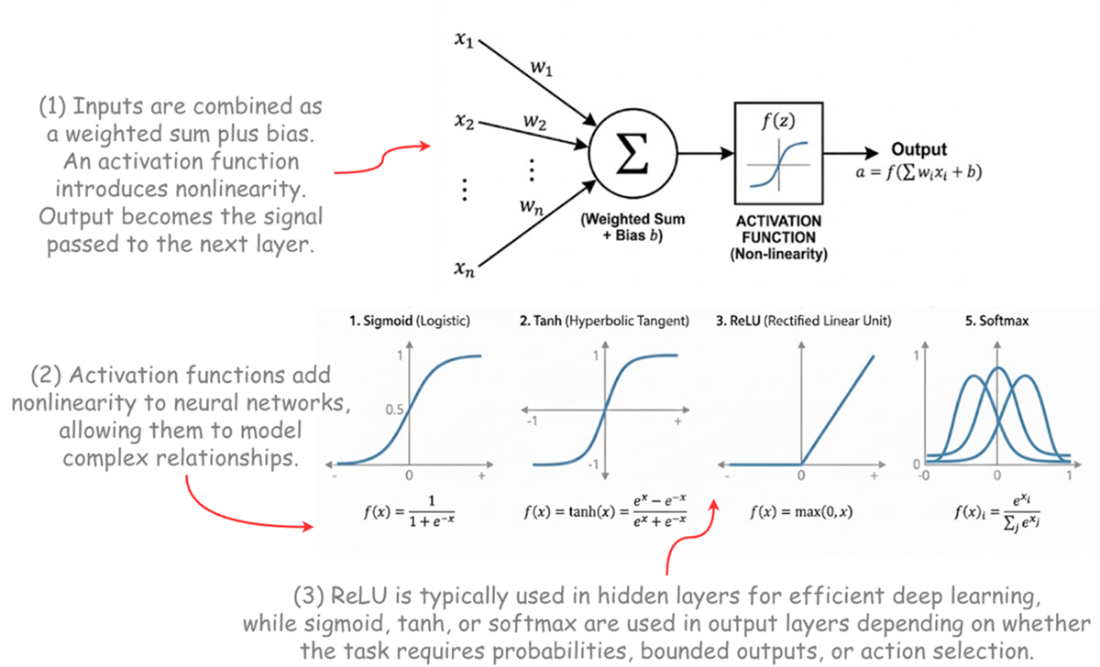
A neuron-level diagram helps visualize where activation functions fit in a network. section 8.2


How Applied Reinforcement Learning covers it

How deep it goes
Defines the activation’s role after a weighted sum and bias, and explains why stacking layers requires nonlinearity.
Examples
Uses ReLU in hidden layers and linear outputs for Q-values as architectural examples.
What you can do after
Understand why neural networks use nonlinear activations and how hidden-layer activations differ from Q-value outputs.
How it connects
Connects activation functions to neurons, forward passes, deep networks, ReLU, and Q-values.

Also explained in

Compare how 20 books explain activation function →

Related concepts

This explainer was generated by Manning's knowledge graph from the text of Applied Reinforcement Learning. The section links point to the parts of the book it draws on.
















