AdaBoost, short for adaptive boosting, combines weak learners into a stronger classifier. Unlike bagging, it trains learners sequentially: each new learner focuses on points misclassified by earlier ones. section 12.1 section 12.3
A classification example builds the model in these steps:
- Assign each point an initial weight of 1, then fit a depth-1 decision tree to the full dataset. section 12.3
- Increase the weights of misclassified points and train another learner on the reweighted dataset. section 12.3
- Score learners using log-odds based on accuracy; combine their predictions as weighted votes to produce the final classification. section 12.3
Classifying spam
A Scikit-Learn example trains six weak learners on email features counting the words “lottery” and “spam.” An exercise asks for a boosted prediction from three learners’ weights and votes. section 12.3 section 12.8
Figure 12.14 How to combine the weak learners into a strong learner in the AdaBoost model. We score each of the weak learners using the log-odds and make them vote based on their scores (the larger the score, the more voting power that particular learner has). Each of the regions in the bottom diagram has the sum of the scores of the weak learners. Note that to simplify our calculations, the predictions from the weak learners are +1 and –1, instead of 1 and 0.
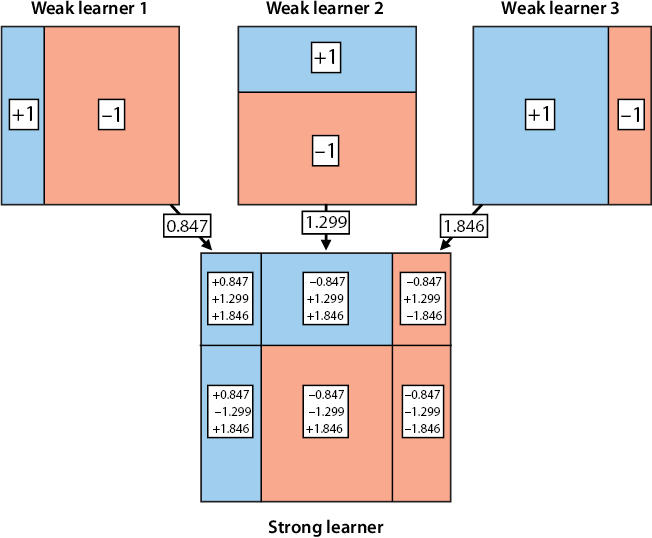
Visualizes how log-odds scores give weak learners different voting power and combine their predictions. section 12.3

