Adam is an adaptive form of stochastic gradient descent. It keeps momentum from earlier updates, helping parameters move faster toward lower loss and sometimes pass a small local minimum. section 4.1.2
Adam trades training memory for potentially more effective optimization:
- It can minimize the loss function faster and reduce the chance of getting stuck in a local minimum. section 4.1.2
- It stores momentum information for each parameter, raising memory requirements to about three times those of plain SGD. section 4.1.2
- That extra information can be discarded after training, but the larger training system is still required beforehand. section 4.1.2
A ball rolling down a loss curve
Imagine gradient descent as a ball moving downhill. Adam gives the ball momentum: repeated movement in one direction makes it roll faster and may carry it past a shallow dip instead of leaving it at a local minimum. section 4.1.2
Figure 4.5 The gradient descent algorithm takes steps to adjust parameters to find the optimal outcome with the least loss. Unfortunately, the algorithm gets stuck in a local minimum, an area of the graph that is not optimal because other parameter values correspond to areas with a lower loss.
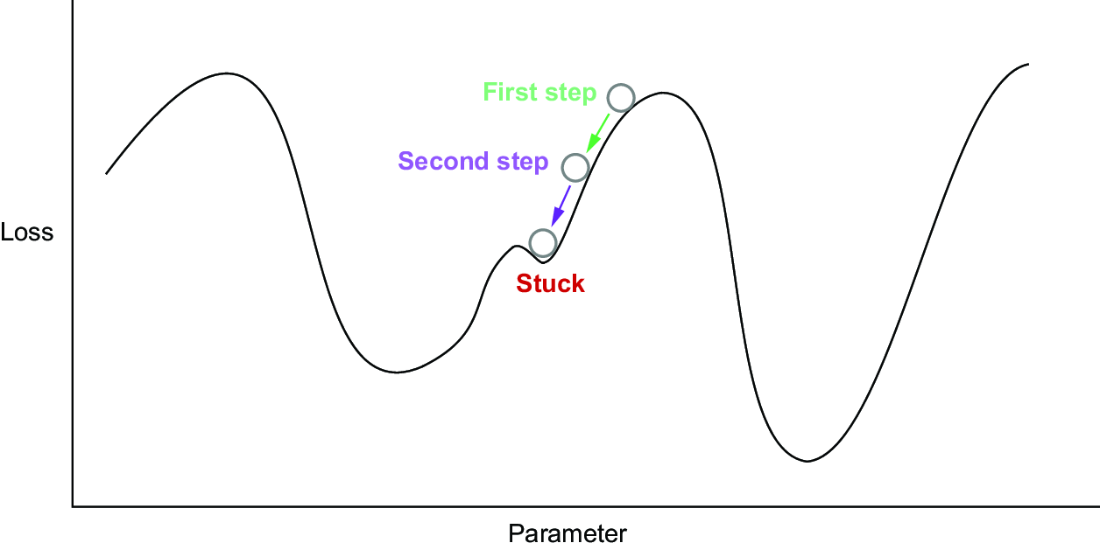
See how ordinary gradient descent can stop at a local minimum, clarifying the problem Adam’s momentum is intended to help address. section 4.1.2






