Adam is an adaptive optimization method for stochastic neural-network training. It combines momentum-like first-moment estimates with RMSProp-like second-moment scaling, producing larger progress in gently sloped directions and more cautious updates where gradients are large. section 10.4
The method smooths the stochastic gradient rather than using the raw gradient, then applies a bias-correction mechanism to its moment estimates. Recommended settings are ε = 1e−8, β1 = 0.9, and β2 = 0.999. section 10.4
Adam connects two optimization ideas:
- Momentum contributes a first-moment estimate, which smooths the direction of the stochastic gradient. section 10.4
- RMSProp contributes exponentially weighted second-moment scaling, emphasizing recent gradient history over distant history. section 10.4
- Bias correction compensates for initialization effects in the moment estimates. section 10.4
LeNet on CIFAR-100
A LeNet network trained on the CIFAR-100 dataset provides an optimizer comparison using Keras/TensorFlow. Adam and Nesterov Momentum experimentally produce the highest validation accuracy among the compared optimizers. section 10.4
Figure 10.13 Cross-entropy loss and validation accuracy of LeNet trained on cifar100 using different optimizers
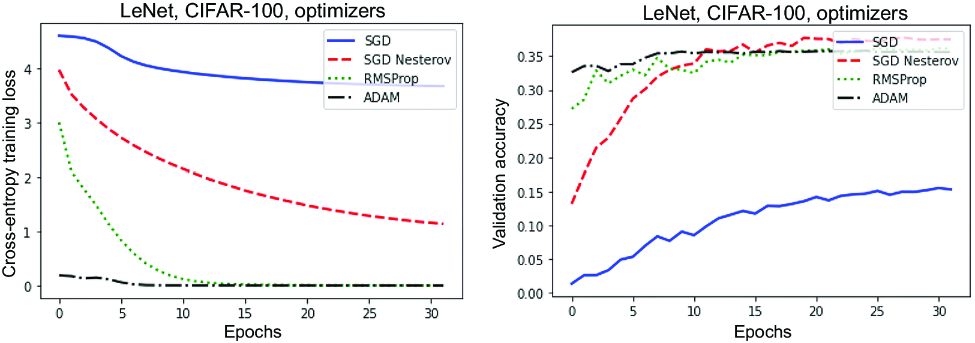
Compare cross-entropy loss and validation accuracy for LeNet trained on CIFAR-100 with different optimizers. section 10.4






