Suppose you want to know whether increasing engagement in an online game causes more in-game purchases. Players who spend more time playing may both engage more and purchase more, so comparing engaged and less-engaged players does not necessarily answer the intervention question. An adjustment set identifies which observed variables to account for when estimating that causal effect. section 10.3.1 section 11.3
For a treatment X and outcome Y, an adjustment set Z satisfies the backdoor criterion: together, its variables block every backdoor path from X to Y, and none is a descendant of X. In a causal DAG, a backdoor path can carry an association through a common cause rather than through the effect of X on Y. Blocking those paths lets observed data identify the intervention query under the stated causal assumptions. section 10.3.1
Figure 10.8 E←G→I is a backdoor path where G is a “confounder” that is a common cause of E and I. We are interested in the statistical signal flowing along the causal path from E to I, but that signal is “confounded” by the noncausal noise from additional statistical information through G on the backdoor path E←G→I.
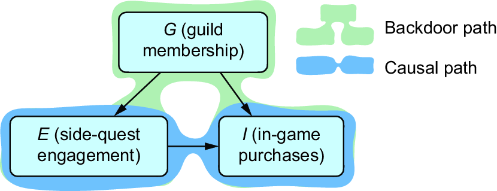
The path E←G→I shows how a common cause G can confound the apparent relationship between E and I. Adjusting for G blocks that backdoor path. section 10.3.1
Operationally, backdoor adjustment averages the outcome distribution within each value of Z, weighted by how common that value is: P(Y | do(X=x)) = Σz P(Y | X=x, Z=z)P(Z=z). For continuous adjustment variables, the corresponding operation is integration. The formula uses observational quantities to answer a causal query; it does not make an invalid adjustment set valid. section 10.3.1
Selecting variables for a purchase-effect estimate
For the effect of Side-quest Engagement on In-game Purchases, Guild Membership, Time Spent Playing, and Player Skill Level form a valid adjustment set. Prior Experience is unobserved, but the selected variables still block the backdoor path through it. In DoWhy, supply the data, treatment, outcome, and DAG to CausalModel, then call identify_effect() to inspect the backdoor estimand and its assumptions. section 11.4.1 section 11.3 section 11.3.1
After identification, keep variable selection distinct from estimation:
- A linear regression can include the adjustment variables as covariates; its treatment coefficient estimates the average treatment effect when that estimator is appropriate. section 11.4.1
- Double machine learning and meta learners offer other ways to estimate the backdoor effect using the adjustment variables. section 11.4.3
- Do not control for every available covariate: adjusting for a mediator can block the causal path of interest, while adjusting for a collider can introduce bias. section 11.4.1
- Check sensitivity to omitted common causes. If an important confounder leaves a backdoor path open, the estimated effect can change substantially. section 11.5.5

