An adjustment set is a group of variables to condition on when estimating the causal effect of treatment X on outcome Y. It blocks back-door paths that create spurious correlations while leaving causal paths available for the adjustment formula. section 7.2
Find adjustment sets from a causal diagram, not from predictive performance alone: list paths between treatment and outcome, identify every back-door path, and choose variables that close those paths. Avoid opening a closed path by conditioning on a collider. section 7.2 section 7.2.1
Warm-up exercises and sports injury
Several sets can identify the causal effect of warm-up exercises on injury, including Coach and Fitness Level, Coach and Pregame Proprioception, or Fitness Level and Genetics. Each set closes the relevant back doors, although different admissible sets may have different variances. section 7.2.1 section 7.2
Adjustment sets can be equivalent for bias but unequal for precision. Adding an outcome predictor can reduce residual noise and estimator variance; adding a highly related treatment predictor can worsen precision. The best efficient set remains problem-dependent. section 7.4.1
Simplified types of paths between X and Y. Any path between X and Y is either a direct path or contains one of the three elements: a confounder, a mediator, or a collider. If the graph gets complex, we can have paths with more than one of these elements.
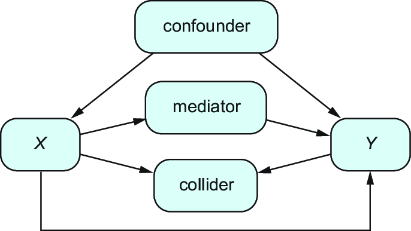
Use the path diagram to distinguish direct paths, confounding paths, mediators, and colliders before selecting variables to condition on. section 7.2

