A threat-hunting expedition is a bounded, hypothesis-driven investigation that proactively tests whether an attack or threat has evaded existing detection. It turns a defined hunting play into evidence-gathering work: search available data, interpret clues, and determine whether the hypothesis is supported. section 2.1 section 1.5
Preparation gives an expedition direction. Define the hypothesis, scope, threat landscape, validation approach, and required data and tools in a hunting play before execution. This structure makes hunts repeatable and measurable while leaving room to adjust techniques when data, access, parsing, or search performance is limited. section 2.1 section 1.5
During execution, hunters typically:
- Translate planned procedures into an initial set of searches. section 3.2.2
- Follow evidence through events and related systems, building a threat-execution timeline. section 3.0
- Open or update an incident case when findings require incident-response involvement. section 3.2.2 section 4.3.2
- Record findings, data-collection gaps, and recommendations that improve later hunts and detections. section 4.6
Tracing a malicious document
A suspicious Word attachment that bypasses endpoint controls becomes the hypothesis: similar activity may exist elsewhere. Search Sysmon process-creation events for Word spawning PowerShell, then pivot from a created .ps1 file to related cscript, PowerShell, cmd, and rundll32 events. Arrange the resulting events by time to reconstruct the execution chain and identify the affected endpoint. section 3.1.1 section 3.1.4
Figure 3.9 Threat-hunting process: Execution phase
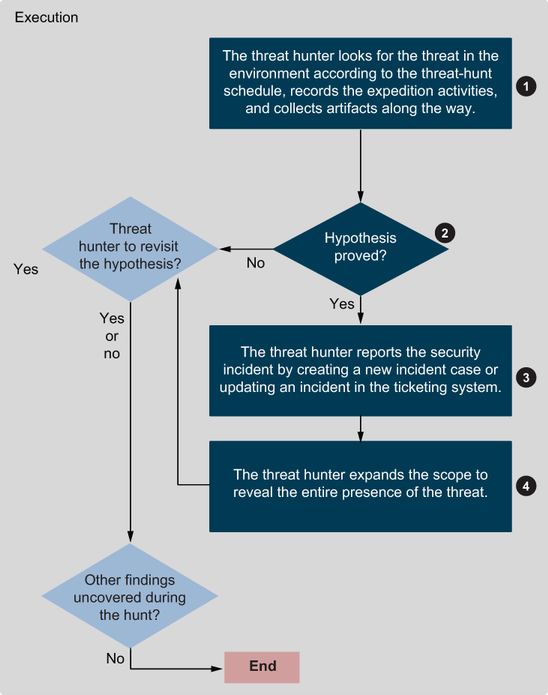
Use the execution-phase diagram to orient the transition from planned searches to evidence, incident handling, and scoped findings. section 3.2.2
An expedition need not prove its hypothesis to be useful. A negative or inconclusive result can reflect an absent threat, incomplete environmental context, missing data, unsuitable techniques, or unfamiliar technology. Discuss those constraints, research relevant TTPs, and seek alternate data sources rather than treating the outcome as failure. section 1.5
Expeditions also produce operational value beyond confirmed attacks: vulnerabilities, configuration problems, detection-rule ideas, and information for partner teams. Their results can be tracked through counts of expeditions, incidents, vulnerabilities, configuration findings, monitoring rules, and support provided to incident work. section 12.5.3 section 4.6
