Alignment training shapes an AI model toward intended goals, human values, and safety constraints. Common approaches include fine-tuning and reinforcement learning from human feedback (RLHF), but alignment does not guarantee harmless or human-identical behavior. section 13.3.3 section 12.4.3
Apply alignment as part of a broader production safety strategy:
- Inspect model cards and transparency notes to understand safety techniques and known problems. section 13.3.3
- Red-team different model versions and measure potential harms rather than assuming alignment is sufficient. section 13.3.3
- Layer model-level alignment with safety systems, user review, application controls, and published policies. section 13.3.3
Evaluating moral and causal alignment
The MoCa framework compares LLM judgments about causal and moral scenarios with human participants’ judgments. It uses AuROC as its main alignment metric and accuracy as a secondary measure. Newer, larger models such as GPT-4 and Claude score closer to human judgments than smaller models such as GPT-3, although no model perfectly matches human moral systems. section 12.4.3
Figure 13.11 Harms mitigation layers
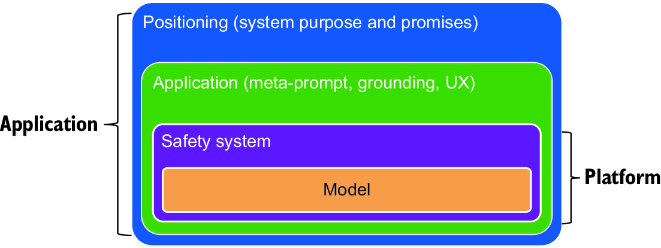
Use the harms-mitigation layers to position alignment training alongside safety monitoring, application design, user interventions, and governance. section 13.3.3





