Alignment training aims to make an intelligent system’s objectives and behavior conform to the values of the people or population it serves. In RLHF, human preferences become an optimizable learning signal rather than a fixed environment reward. section 5.0 section 10.1
Reward models operationalize this goal by compressing complex human judgments into scalar rewards or preference probabilities. The resulting proxy objective guides reinforcement learning, while empirical methods often optimize specific skills rather than directly measuring conformity to values. section 5.0 section 10.1
Alignment training connects several distinct problem settings:
- RLHF learns reward signals from human preference comparisons instead of receiving fixed environment rewards. section 5.0
- Inverse reinforcement learning estimates an agent’s reward function from behavioral trajectories, sharing the high-level alignment problem but differing in implementation and emphasis. section 5.0
- Pluralistic alignment studies how systems can account for values across populations through research, datasets, and personalization. section 10.1
Preference-based reward
Given two candidate answers, a Bradley–Terry reward model predicts the probability that one answer is the preferred, higher-quality response; reinforcement learning can then optimize that learned signal. section 5.0
Figure 5.1 The RM in RLHF plays the role of the environment component that returns rewards in standard RL. The key difference is that in RLHF, we get to control and learn this reward function from human preferences, rather than it being fixed by the environment.
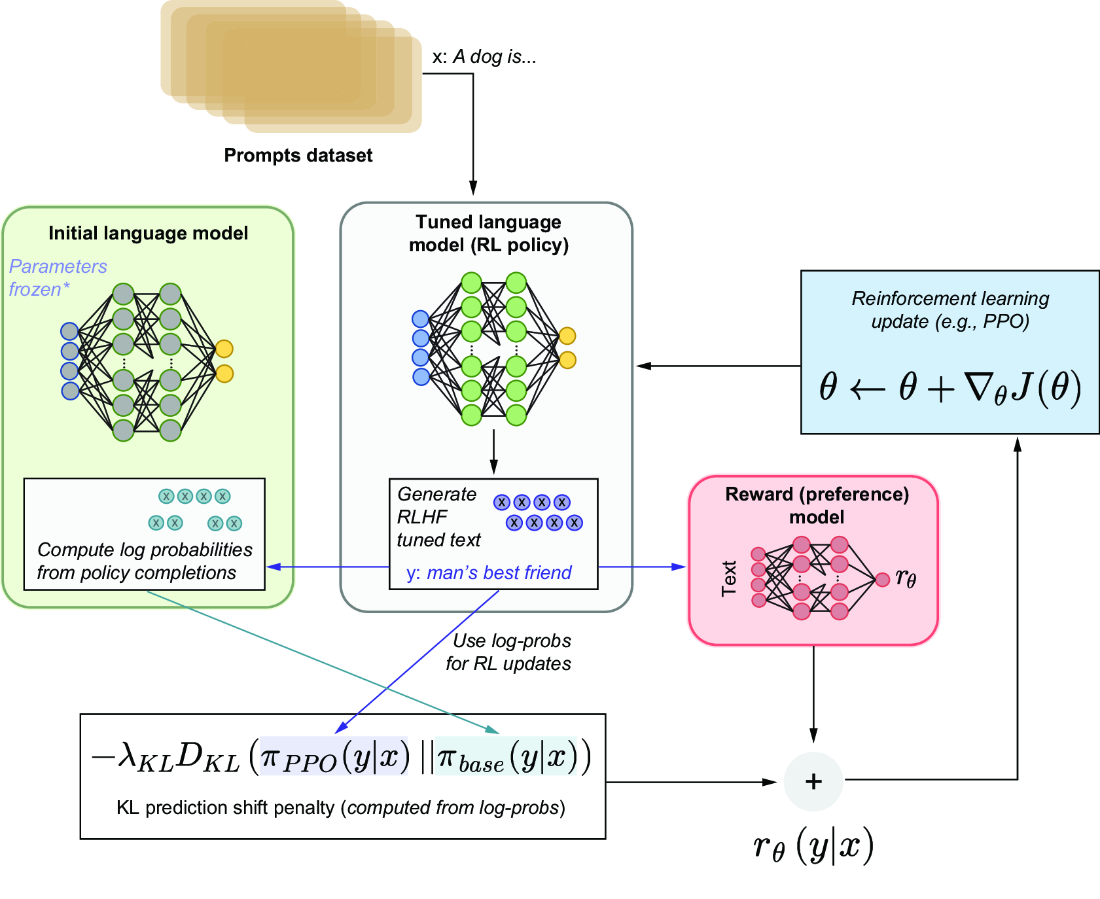
Compare the learned reward model with the fixed environment component in standard reinforcement learning. section 5.0





