Anomaly detection identifies observations or behaviors that deviate substantially from an expected pattern. It commonly operates as an unsupervised task: the algorithm finds patterns without a target variable, then flags distinguished outliers for attention. section 1.5.2
Useful detection signals include:
- Unsupervised algorithms learn structure from input data without labels and use departures from discovered patterns to identify anomalies. section 1.5.2
- Autoencoders use reconstruction error—the difference between actual and reconstructed data—as an anomaly signal. section 9.6
- UMAP can support anomaly-detection analysis by preserving both local and global structure, especially in complex datasets. section 6.5.3
Network monitoring
A network provider can use historical data with an unsupervised algorithm to find recurring patterns. The resulting outliers become distinguished anomalies that require investigation. section 1.5.2
Figure 1.16 An unsupervised learning algorithm finds patterns in the data on the left and results in clusters on the right.
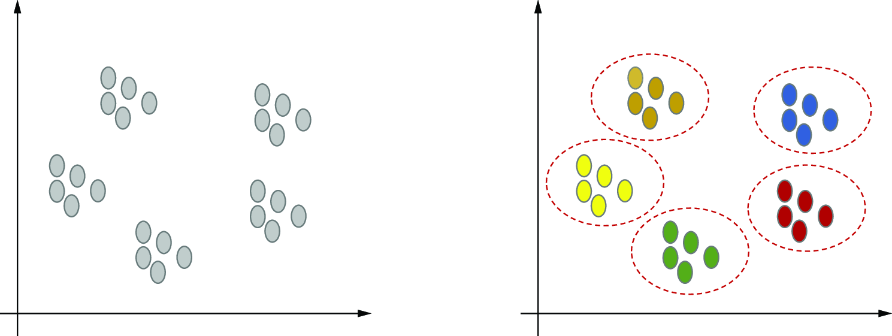
View how unsupervised learning transforms raw data points into discovered patterns and clusters, the structural basis for identifying unusual points. section 1.5.2






