A deployment manifest turns deployment documents into a descriptive, repeatable definition of an application’s required resources and configuration. It belongs alongside container packaging: Dockerfiles capture installation steps, while manifests describe how the application should run across environments. section 1.1.1
Use a manifest to:
- Describe a containerized application for Docker Compose or Kubernetes. section 1.1.1
- Keep deployment behavior consistent from a laptop to the cloud or a datacenter. section 1.1.1
- Separate deployment configuration from application code, avoiding code changes during container migration. section 1.1.1
Container migration
For an existing application, script the installation steps in Dockerfiles and express the deployment documents as a Docker Compose or Kubernetes manifest. The resulting application can run with the same technology stack on a laptop, in a datacenter, or in the cloud. section 1.1.1
Figure 1.2 The same app, migrated to Docker before moving to the cloud. This application has the cost benefits of PaaS with the portability benefits of IaaS and the ease of use you get only with Docker.
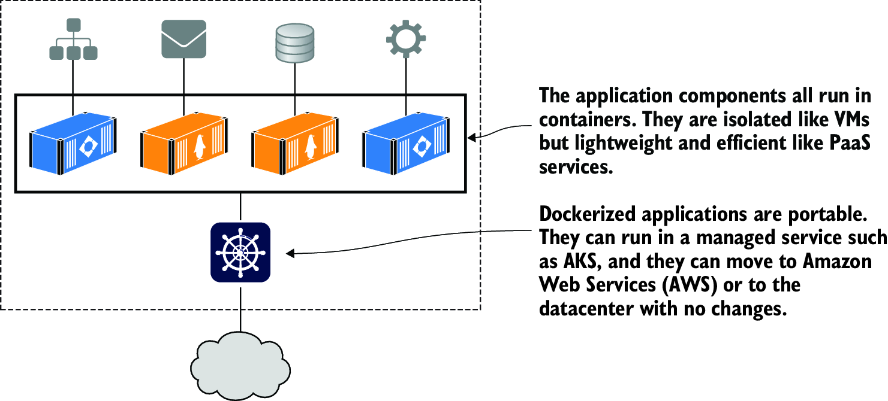
The migration diagram connects manifests with the broader goal of packaging an application for portable cloud deployment. section 1.1.1


