Address Resolution Protocol (ARP) resolves an IPv4 address to a MAC address so a host can place an IP packet inside an Ethernet frame. It uses an ARP request, broadcast to ffff.ffff.ffff, followed by an ARP reply, sent as a unicast frame. section 6.4
An ARP exchange works as follows:
- The sender broadcasts an ARP request naming the target IPv4 address. section 6.4
- Switches flood the request throughout the broadcast domain; hosts that do not own the requested IP address ignore it. section 6.4 section 10.3
- The host owning the IPv4 address returns an ARP reply containing its MAC address. section 6.4
- Both devices can record IP-to-MAC mappings in their ARP tables, avoiding a new request before every packet. section 6.6 section 10.3
ARP resolves the MAC address needed on the current LAN, not necessarily the final destination. For a remote IPv4 destination, an end host resolves its default gateway’s MAC address. Each router then resolves the next hop’s MAC address; the final router resolves the destination host’s MAC address. section 10.1.1 section 10.1.2
PC1 sends to PC3
PC1 wants to reach PC3 at 192.168.3.11, which is outside PC1’s local network. PC1 uses ARP for the MAC address of its default gateway, R1 at 192.168.1.1, then sends the frame to R1. R1 routes the packet and uses ARP for R2’s MAC address; the final router uses ARP for PC3’s MAC address. section 10.1.1 section 10.1.2 section 10.1.4
Figure 6.6 An ARP request and reply exchange between PC1 and PC3. PC1 wants to send a message to PC3 but does not know PC3’s MAC address, so PC1 uses ARP to learn PC3’s MAC address.
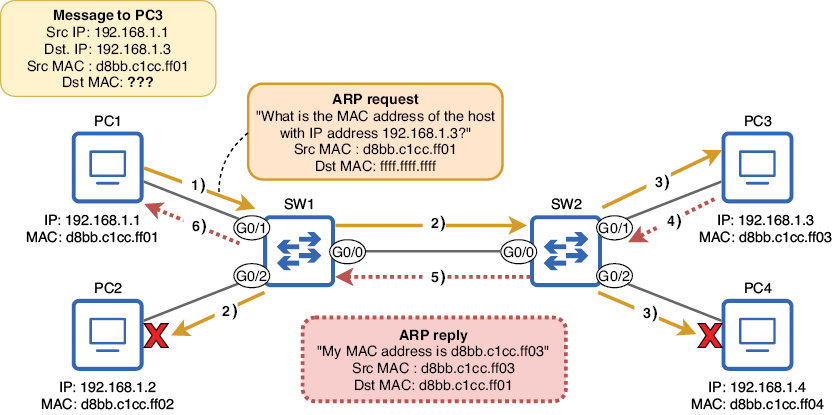
Trace the broadcast ARP request from PC1 through the switches and the unicast reply from PC3 back to PC1. section 6.4

