Isolation keeps workloads, data, and failures within defined boundaries. The boundary should match the risk: separate workflow execution environments, scope searches to team indexes, or bound each tool invocation so failures do not cascade. section 2.2.2 section 5.2.1
Choose the boundary according to the tradeoff or failure to contain:
- Plain processes start quickly and use few resources, but offer weak isolation and can interfere with one another. Virtual machines provide stronger isolation but impose substantial resource and startup costs. Containers balance isolation, resource use, and startup speed, with resource limits and network policies controlling access. section 2.2.2
- Scope searches to a team's index. Per-index embedding and chunking settings let teams optimize for their content without changing another team's configuration. section 5.2.1
- Bound each tool invocation's resources so an infinite loop, malformed response, or oversized payload does not cascade to other tools, sessions, or the service. section 6.5
Figure 2.1 Three approaches to isolating workflows: plain processes provide weak isolation with shared resources but fast startup; virtual machines offer strong isolation but require minutes to start and consume hundreds of megabytes per instance; containers provide the optimal balance with strong isolation, lightweight resource usage, and startup times measured in seconds.
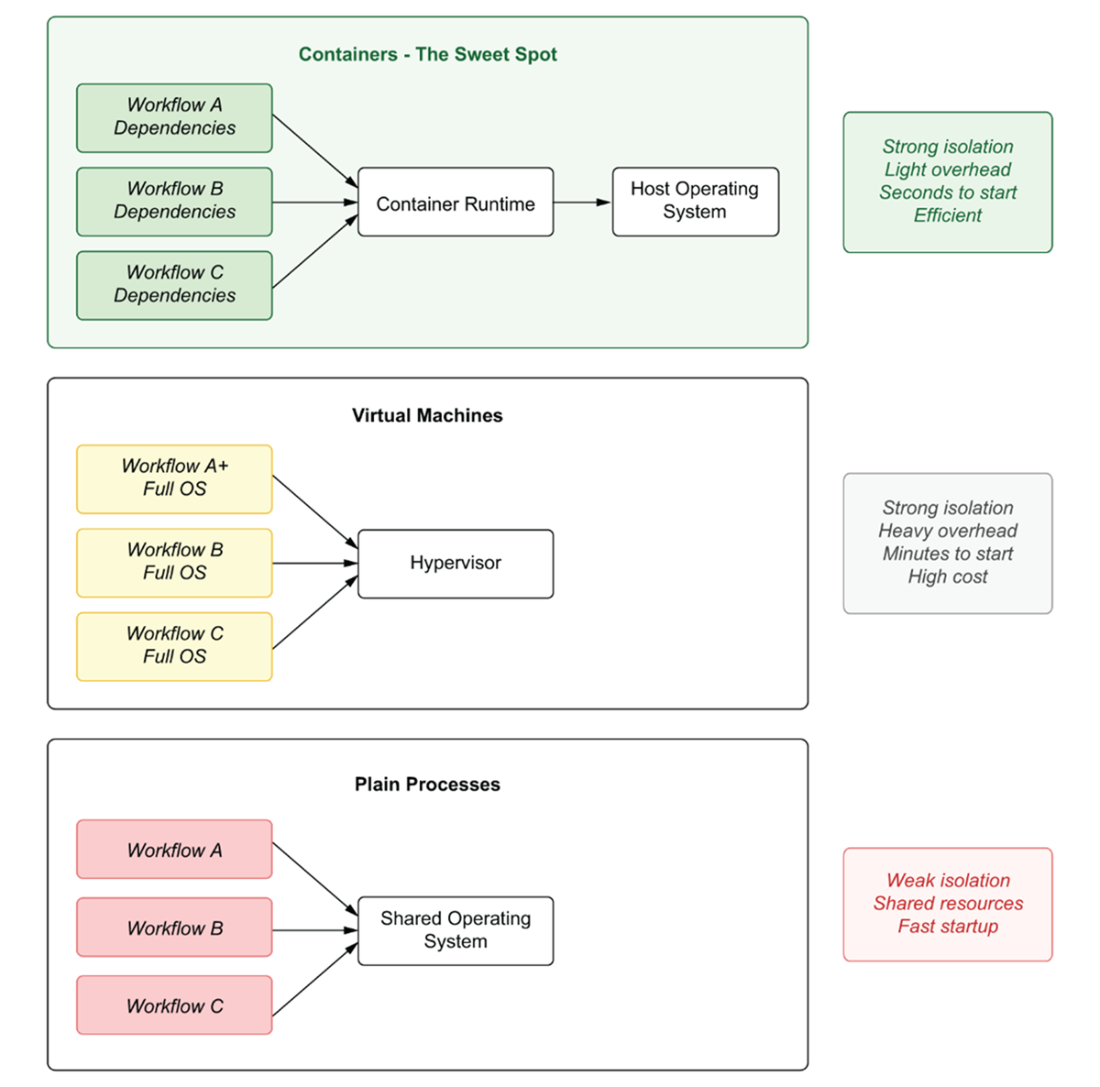
Compare process, virtual-machine, and container isolation by strength, resource overhead, and startup time. section 2.2.2
Figure 5.2 Index isolation in the Data Service. Two teams (Support and Legal) each maintain their own index. Each index has its own embedding model configuration, chunking strategy, and document collection. Searches are scoped to a specific index, ensuring that a support query never returns legal documents and vice versa. The Data Service manages all indexes through a unified interface while enforcing isolation boundaries.
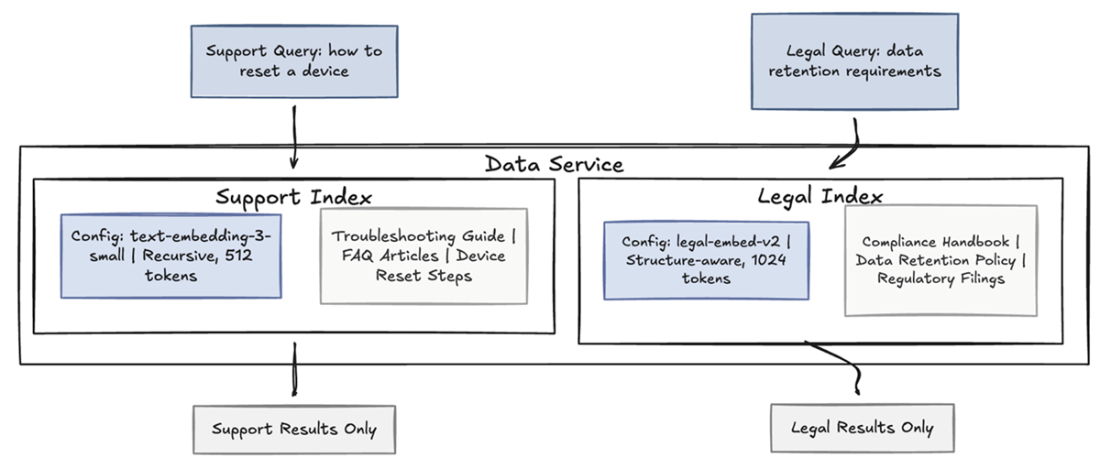
See how separate team indexes scope document collections, search, embedding models, and chunking strategies. section 5.2.1














