An automaton is a system that executes predefined instructions or behavioral rules without flexible, general-purpose intelligence. It is static and crafted for specific tasks in specific contexts: “If this, then that.” section 19.2.1 section 19.2.2
Automata can be biological or artificial. Early brains executed behavioral programs hardcoded in DNA; thermostats, list-sorting programs, and trained deep neural networks provide comparable examples of rule-bound behavior. section 19.2.1
Automata differ from intelligent agents in several practical ways:
- An automaton follows its programming, whether written by humans, generated by evolution, or learned from a training dataset. section 19.2.2
- A rigid automaton cannot handle situations that were not specified in advance; lookup tables, dictionaries, and hardcoded if-else question-answering programs illustrate this limit. section 19.2.2
- Deep networks may show local generalization by handling inputs that differ slightly from familiar examples, but this remains distinct from extreme generalization. section 19.2.2
- Intelligent agents adapt to novel situations by using abstraction, reasoning, anticipation, planning, and rapid skill acquisition. section 19.2.2
A biological behavioral automaton
The brain network of the C. elegans worm illustrates a behavioral automaton: natural evolution effectively programs the network to execute behavioral rules. section 19.2.1
Figure 19.5 The brain network of the C. elegans worm: a behavioral automaton “programmed” by natural evolution. Figure created by Emma Towlson (from Yan et al., “Network control principles predict neuron function in the Caenorhabditis elegans connectome,” Nature [2017]).
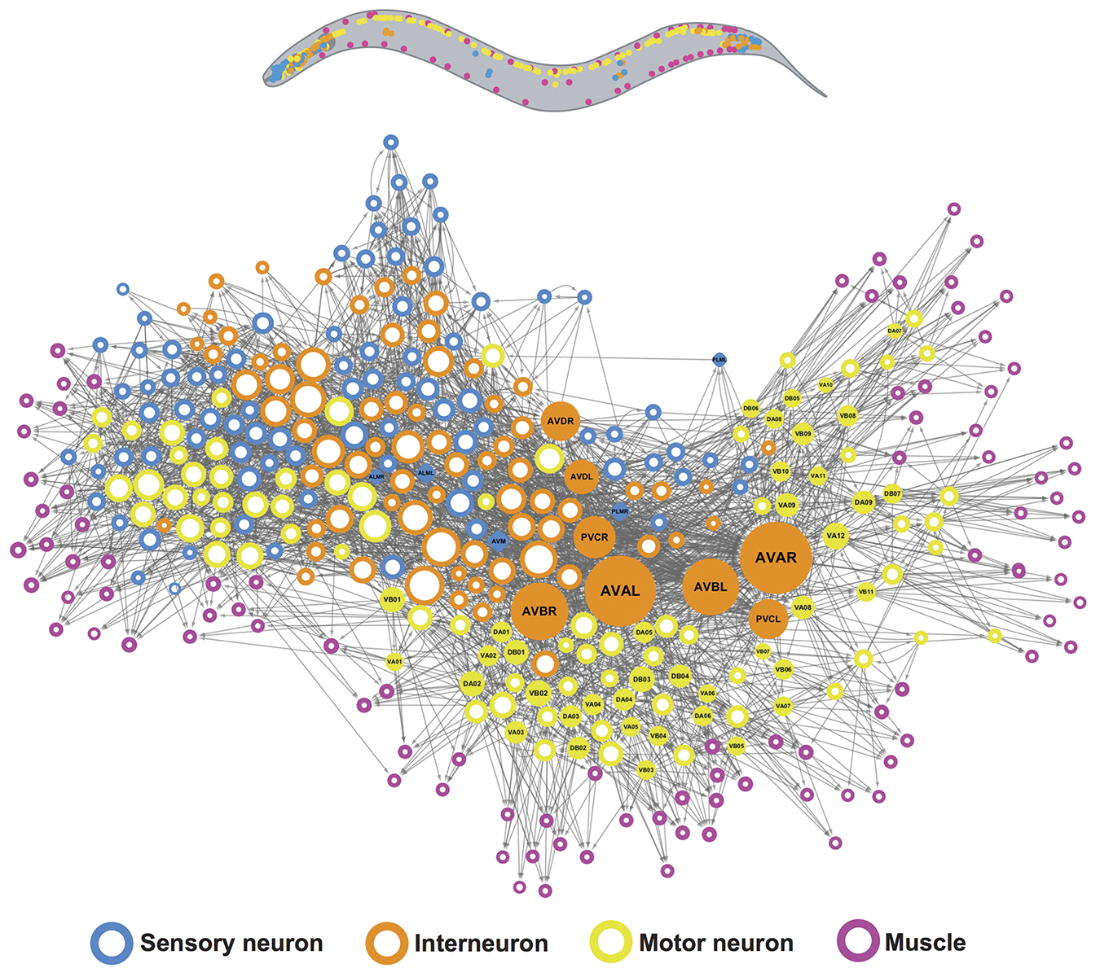
Inspect the C. elegans brain-network figure as an example of a naturally programmed behavioral automaton. section 19.2.1
Figure 19.6 Local generalization vs. extreme generalization
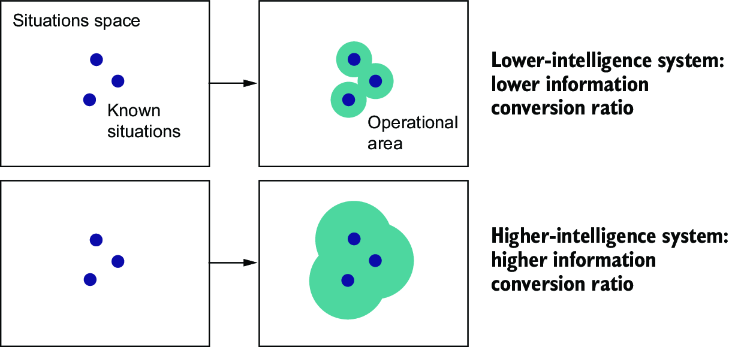
Use the local-versus-extreme-generalization figure to compare limited adaptation with flexible handling of novel situations. section 19.2.2
