The human brain coordinates bodily activity, processes sensory information, and supports thought and memory. It is also a useful reality check when comparing human abilities with AI: impressive pattern recognition does not mean a machine thinks or perceives as a person does. Much about how the brain produces thought remains unknown. section 6.1 section 6.1.1 section 6.0
Around 100 billion neurons communicate through electrical impulses and chemical signals. Sensory neurons carry information from organs such as the eyes and ears toward the brain; motor neurons relay instructions to muscles; other neurons include interneurons. This gives a basic picture of communication, not a complete account of cognition. section 6.1.1 section 6.1
Figure 6.1 Image of a typical neuron (courtesy of Wikimedia Commons, CC BY-SA 3.0)
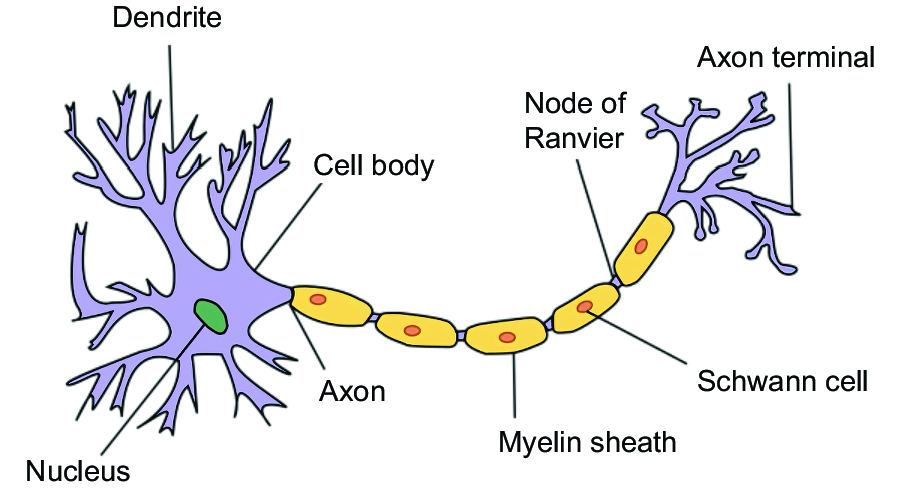
A labeled image of a typical neuron helps make the biological cell concrete before comparing it with an artificial neuron. section 6.1.1
Automatic answer or deliberate thought?
Multiplying 5 by 4 or spelling your own name may feel immediate. Finding the square root of 529 or spelling “onomatopoeia” may require deliberate effort. The contrast illustrates when people notice themselves thinking; it does not explain how thoughts arise. section 6.1.1
Memory shows both what the brain can do and what remains uncertain. A sound or smell can bring back a vivid experience, unlike a computer retrieving stored binary data. After surgery removed half his hippocampus, Henry Molaison could no longer form new long-term memories. His case helped establish the hippocampus’s role in memory formation, without revealing a complete account of how memories are stored and retrieved. section 6.1.2
Brain–computer interfaces have shown promise in rehabilitation, including helping a person with a paralyzed hand bypass a damaged spinal cord. That practical result should not be stretched into a claim that minds can soon be uploaded. Likewise, an artificial neuron in a deep-learning network should not be mistaken for a biological neuron. Treat such comparisons as prompts for careful questions, not proof of human-like intelligence. section 9.3
