When estimating how engagement changes in-game purchases, an observed association can mix the direct effect of engagement with information carried by a common cause. The backdoor criterion identifies which covariates remove that confounding so the intervention-level effect can be estimated. section 10.3.1
A covariate set satisfies the backdoor criterion when it d-separates every backdoor path from treatment X to outcome Y and contains no descendants of X. Adjusting for such a set blocks noncausal statistical signal while preserving the causal path of interest. section 10.3.1
Use the criterion to guide adjustment decisions:
- Block paths entering treatment through a common cause, such as E←G→I, by adjusting for G. section 10.3.1
- Choose any valid adjustment set; adjusting for every available covariate is neither necessary nor safe. section 11.4.1
- Avoid mediators, which block part of the causal effect, and colliders, which introduce collider bias. section 11.4.1
- After identification, estimate the effect with an appropriate model; linear regression remains subject to ordinary modeling considerations such as linearity. section 11.4.1
Gaming engagement and purchases
Suppose E is side-quest engagement and I is in-game purchases, while G is a common cause. Adjusting for Guild Membership, Time Spent Playing, and Player Skill Level blocks the relevant backdoor paths; Prior Experience is unnecessary because the other variables suffice, even though adding it would remain valid if observed. section 10.3.1 section 11.4.1
Figure 10.8 E←G→I is a backdoor path where G is a “confounder” that is a common cause of E and I. We are interested in the statistical signal flowing along the causal path from E to I, but that signal is “confounded” by the noncausal noise from additional statistical information through G on the backdoor path E←G→I.
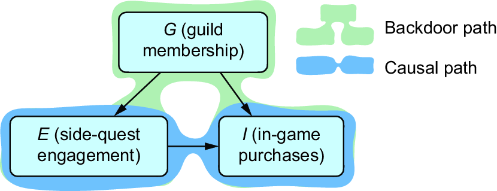
Inspect the DAG showing how a common cause creates the backdoor path E←G→I and confounds the causal signal from E to I. section 10.3.1

