When choosing a shoe price from historical sales rather than an A/B test, the goal is not to predict sales but to estimate what sales would be under each price. The back-door criterion uses a causal DAG to decide which observed variables belong in an adjustment set for estimating the average treatment effect. section 7.0 section 7.2.1
For treatment X and outcome Y, a set Z satisfies the criterion when it blocks every back-door path from X to Y and contains no descendant of X. A back-door path begins with an arrow entering X; such paths can create spurious association through confounding. Excluding descendants prevents conditioning from blocking part of X's causal effect on Y. section 7.2
Use the criterion after drawing a DAG from domain knowledge. List the paths between treatment and outcome, identify the back-door paths that remain open, and select variables that close all of them without conditioning on descendants of the treatment. Colliders require care: conditioning can open paths rather than close them. section 7.2 section 7.8
Warm-up exercises and injury
For a DAG relating warm-up exercises to injury, several distinct sets can satisfy the criterion, including Coach plus Fitness Level, or Fitness Level plus Genetics. Once a valid set is found, it can be used in the adjustment formula; software such as Dagitty can compute valid sets from a drawn graph. section 7.2.1
A valid adjustment set supports the adjustment formula regardless of whether estimation uses linear models, propensity scores, machine learning, or another variation. Statistical modeling does not replace the causal work of deciding what to adjust for. In a linear regression for a total effect, controlling for a set that closes every back-door path and excludes descendants of X yields an unbiased coefficient for X under the stated DAG conditions. section 7.2.1 section 7.4.5
Table 7.7 Different stages in searching for back-door closing variables
General pricing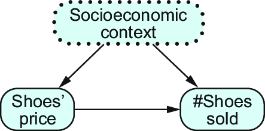
We cannot estimate the causal effect.
|
Stock is the key.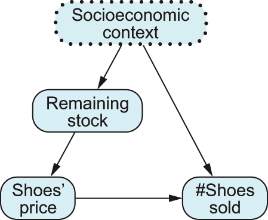
We can estimate the causal effect, adjusting for Remaining Stock.
|
Overcoming the lack of stock information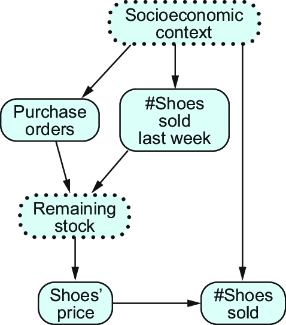
We can estimate the causal effect if we have Purchase Orders and # Shoes Sold Last Week.
|
Follow the pricing progression from an unidentifiable effect to adjustment using remaining stock, then to proxy information when stock is unavailable. section 7.2.1
The criterion depends on the DAG being credible. Data alone generally cannot establish that graph; domain knowledge is needed. If an important confounder is unobserved and no alternative observed variables close the relevant paths, the causal effect cannot be estimated by this adjustment route. section 7.2 section 7.8

