Bayesian statistics revises a belief about an unknown quantity by combining a prior belief with the likelihood of observed data, producing a posterior belief. Relevant evidence can sharply change the posterior; irrelevant evidence leaves the prior unchanged. section 2.1
The update starts with a probability distribution representing what is believed before observing data. Bayes’ theorem then combines that prior with likelihood terms describing how probable the observations are under competing explanations. section 2.1 section 3.1
Estimating a house price
Suppose a house initially has a broad estimated price range of 150k–300k. A nearby, similar house selling for a known price provides relevant evidence and narrows the posterior; a distant, dissimilar house in California does not change the estimate. section 2.1
Testing a claimed psychic
After 100 correct guesses of numbers from 0 to 9, observers can reach different conclusions because they began with different priors. A true psychic has likelihood 1 for a correct guess, while a non-psychic has likelihood 1/10. section 3.1
Figure 2.2 Bayes' theorem, which gives a method of updating a belief about a quantity of interest, represented as a probability distribution of a random variable. Before observing any data, we have the prior belief about X. After being updated with data, we obtain the posterior belief about X.
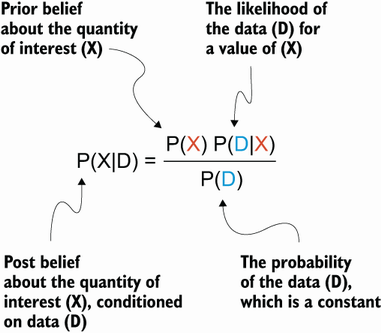
Visualizes the transition from a prior distribution before observation to a posterior distribution after incorporating data. section 2.1







