liveBook · Manning

Bit

As explained in Acing the CCNA Exam: Volume 1 Fundamentals and Protocols

A bit is the smallest unit of digital information and has one of two possible values, conventionally 0 or 1.

A bit, short for binary digit, is the smallest unit of information used by computers. It has one of two values: 0 or 1. Eight bits make one byte. section 3.2

Computers compute and communicate in binary. On a network, devices send long sequences of bits across a medium; copper wiring can represent 0 and 1 through different voltage levels. section 3.2

Router-to-switch transmission

When a router sends one byte to a switch, changes in the cable’s electrical voltage represent the byte’s sequence of eight 0s and 1s. section 3.2

Figure 3.1 A router sends 1 byte of data to a switch. Changes in the voltage of the electric signal indicate values of 0 or 1.
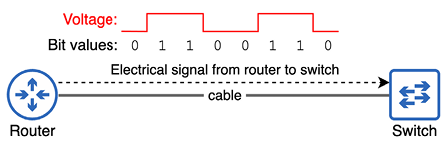
Use the diagram to connect a byte of data with voltage changes traveling from a router to a switch. section 3.2

Exam focus:

How Acing the CCNA Exam: Volume 1 Fundamentals and Protocols covers it

How deep it goes
Defines bits and bytes, then illustrates physical voltage signaling without deriving binary conversion methods.
Examples
Uses a router sending one byte to a switch through voltage changes on a cable.
What it assumes
Starts with everyday digital-data terminology and defines binary, bits, and bytes from first principles.
What you can do after
Understand how binary values form bytes and travel as signals between network devices.
How it connects
Connects binary to bytes, network speeds, Ethernet, copper wiring, and voltage signals.

Also explained in

Compare how 5 books explain bit →

Related concepts

This explainer was generated by Manning's knowledge graph from the text of Acing the CCNA Exam: Volume 1 Fundamentals and Protocols. The section links point to the parts of the book it draws on.