A bit is a binary digit that represents either zero or one. In adaptive phase estimation, bits encode an eigenphase as a binary fraction and are learned one at a time. section 5.3.3
The algorithm first learns the least significant bit from repeated measurements, then adapts later circuits using the bits already discovered, ending with the most significant bit. section 5.3.3
Two-bit eigenphase
For two-bit precision, an eigenphase is written as θ = 0.θ₁θ₂ = θ₁·1/2 + θ₂·1/4, representing values such as 0.25 and 0.75. section 5.3.3
Figure 5.7 In adaptive phase estimation, we learn the phase one binary digit at a time. We start by running a circuit that allows us to learn the least significant binary digit. After this, we use a different circuit, parts of which depend on the information we’ve discovered so far, to learn the second least significant binary digit. If there are more digits to learn, the process is repeated, with different circuits for each digit.
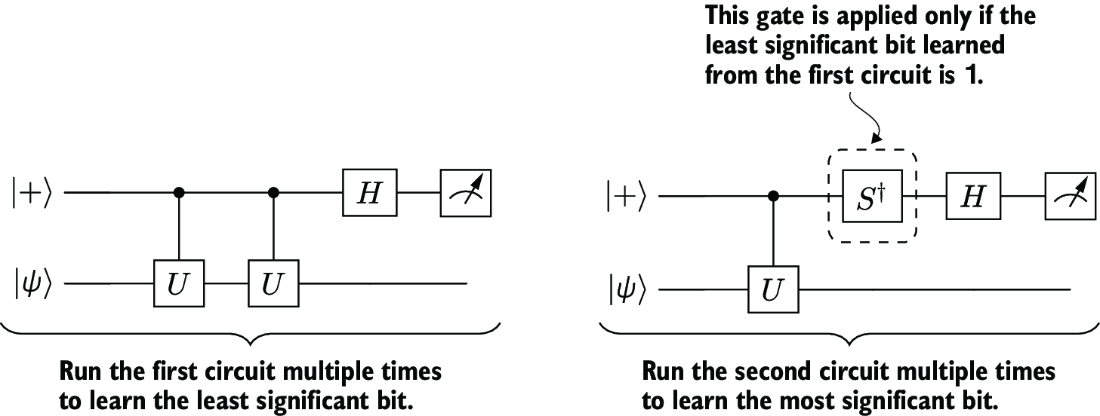
Follow the circuit sequence showing how phase information is learned one binary digit at a time and how later circuits depend on earlier results. section 5.3.3