Block storage persists data as evenly sized blocks that the operating system addresses and a filesystem assembles into files and directories. It provides high throughput and low latency, making it suitable for high-performance computing, Hadoop, and distributed filesystems such as HDFS. section 5.2.1 section 5.2
Figure 5.5 A single file is stored across multiple blocks in a block storage system.
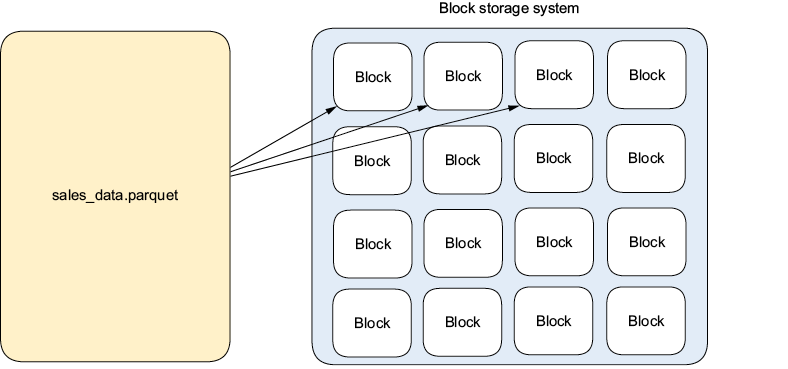
Shows how a single file is distributed across multiple blocks, clarifying the relationship between block-level storage and filesystem-level files. section 5.2.1
Assess block storage through its architectural and operational tradeoffs:
- Use colocated storage and compute for predictable performance, high throughput, and storage locality. section 5.2 section 5.2.1
- Account for coupled scaling, node-level recovery work, and separate systems for replication, permissions, and availability. section 5.2 section 5.2.1
- Prefer it when extending legacy Hadoop environments or operating high-performance private-cloud infrastructure without replacing existing storage. section 5.2.1
- Recognize that it generally provides less elasticity, automation, and cost efficiency than cloud-based object storage. section 5.2.1 section 5.6
Block storage can support Apache Iceberg and enables modernization of table formats over existing infrastructure, but it demands deliberate choices around reliability, scalability, security, performance, and cost. section 5.0 section 5.6

