A business case connects an investment or modernization initiative to concrete organizational benefits, required commitment, and expected return. It gives leaders a shared reason to invest rather than treating modernization as work that happens only when delivery pressure eases. section 2.1.1 section 4.4.1
A useful business case is built as a socio-technical activity. It gathers perspectives, exposes uncertainty, and helps stakeholders decide both what to change and how to pursue the journey. section 4.4.1 section 3.1
Build the case through progressive exploration:
- Start with one domain, identify modernization possibilities, and use lessons learned to inform other domains. section 4.4.1
- Gather individual perspectives and questionnaire responses before convening a voluntary, inclusive workshop. section 4.4.1
- Ask stakeholders about competitive threats, consumer changes, product uniqueness, and the balance between growth and operating-cost reduction. section 3.1
- State the benefits and required compromises clearly enough that leaders can judge the investment and protect modernization time. section 2.1.1
Clinical oncology modernization
An American nonprofit began with one domain in a broad modernization initiative. More than 40 participants explored possible journey models, while the business-case process itself encouraged collaboration and broader contribution to continuous organizational improvement. Participants favored the double diamond or design squiggle over a rigid waterfall process. section 4.4.1
Figure 4.6 The design squiggle (Source: The Process of Design Squiggle by Damien Newman, thedesignsquiggle.com)
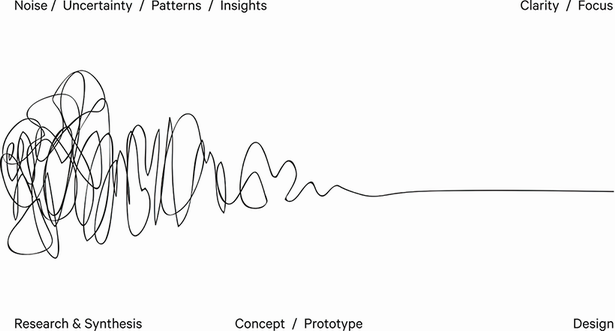
Use the design squiggle to represent uncertainty, backtracking, divergence, and convergence while the business problem and response are still being discovered. section 4.4.1

