A business case justifies an initiative by connecting its expected value to a business priority. Use it as a compass for project decisions, while keeping it distinct from commercial feasibility: a valuable project can still lack funding. section 3.1
Assess the case alongside the conditions that determine whether the initiative can proceed:
- Identify the mechanism for value, such as savings, revenue gains, or improved quality of life. section 3.1
- Check alignment with the customer’s strategic business priorities. section 3.1
- Test technical feasibility, available data resources, infrastructure capacity, and how customers will use the outcome. section 3.1
- Separate business value from commercial feasibility: confirm that funding covers the required work. section 3.1
Use the case to reject unrealistic work
If the evidence indicates that an initiative is likely to fail, push back rather than commit the team. A factual case can support declining the work, protect the team and reputation, and provide material for later learning. section 3.6
Figure 3.1 The project’s drivers (Business Priority and Business Case), the supporting components (Sufficient Funding, Technical Means, and Data Resource), and enablers (Utilization Method).
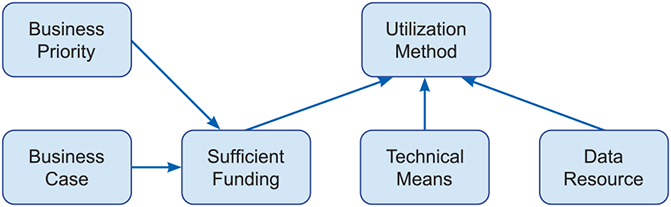
Use the project-drivers diagram to relate business priority and business case to funding, technical means, data resources, and the utilization method. section 3.1

