Business logic is the core of an application’s domain behavior: it contains the rules and computations that act on domain objects. In hexagonal architecture, adapters handle interaction with the outside world while the business logic remains independent of them. section 2.1.1 section 3.3.2
In a hexagonal design, the boundary is organized around ports and adapters:
- Inbound ports expose operations that outside applications can invoke; inbound adapters, such as web controllers or message clients, route requests to them. section 3.3.2
- Outbound ports define how the business logic requests external services; outbound adapters implement them, for example with database access or remote-service clients. section 3.3.2
FTGO
FTGO organizes domain behavior into modules such as Order Management, Delivery Management, Billing, and Payments. In Order Management, the domain interacts with Consumer Management to verify consumers and Delivery Management to schedule deliveries. section 2.1.1 section 3.2.1
Figure 3.16 An example of a hexagonal architecture, which consists of the business logic and one or more adapters that communicate with external systems. The business logic has one or more ports. Inbound adapters, which handles requests from external systems, invoke an inbound port. An outbound adapter implements an outbound port and invokes an external system.
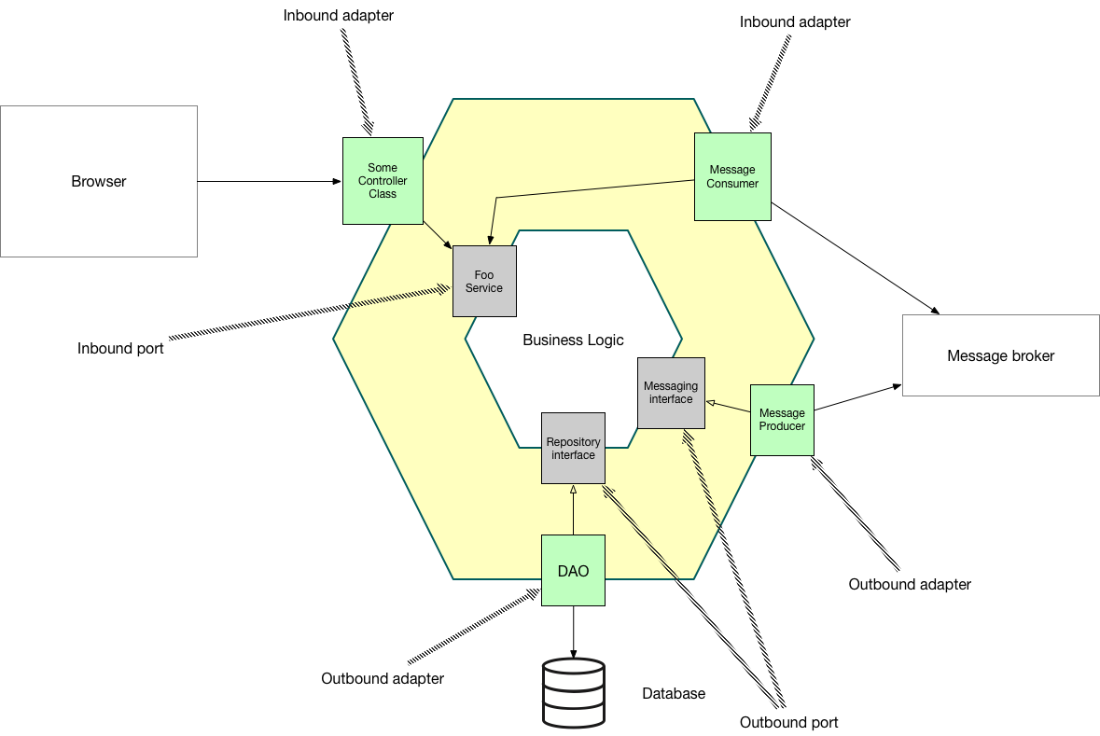
Use the diagram to see how inbound and outbound adapters connect external systems to the business logic through ports. section 3.3.2














