Business logic is the code that implements an application's business requirements and user expectations. It gives an application its distinctive functionality, unlike shared plumbing such as logging, security, transactions, and caching. section 1.1
From user need to business logic
When a user clicks a link to generate an invoice, the code that makes the invoice appear implements business logic. Requesting a car or ordering a pizza are other examples of user-facing use cases. section 1.1
Figure 1.2 The user’s perspective is like viewing an iceberg. Users mainly observe the results of the business logic code, but this is only a small part of what builds the app’s complete functionality. Like an iceberg that is mostly underwater and hidden from view, we don't see most of the code in an enterprise app because it's provided by dependencies.
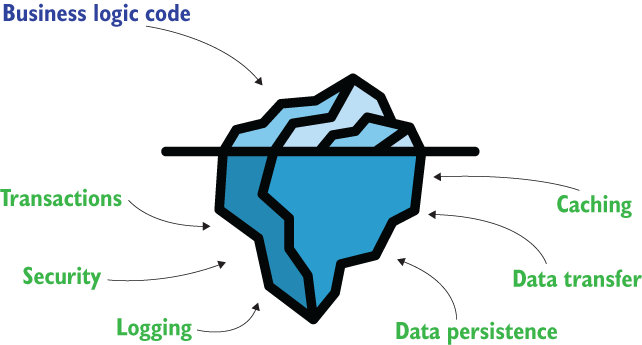
The iceberg analogy shows that users mainly see the results of business logic, while much of an application's supporting code remains hidden. section 1.1














