The Business Model Canvas is a simple visual template for building shared understanding of a company’s strategy and business model. It helps cross-functional teams look beyond an existing system or immediate technical concern, so they can understand what the company needs to succeed and make better decisions together. section 2.3.1 section 2.6
Figure 2.7 The four sections of the Business Model Canvas tool. This canvas gives us an understanding of what we offer, who we offer it to, what we need to do to succeed, and what finances we have.
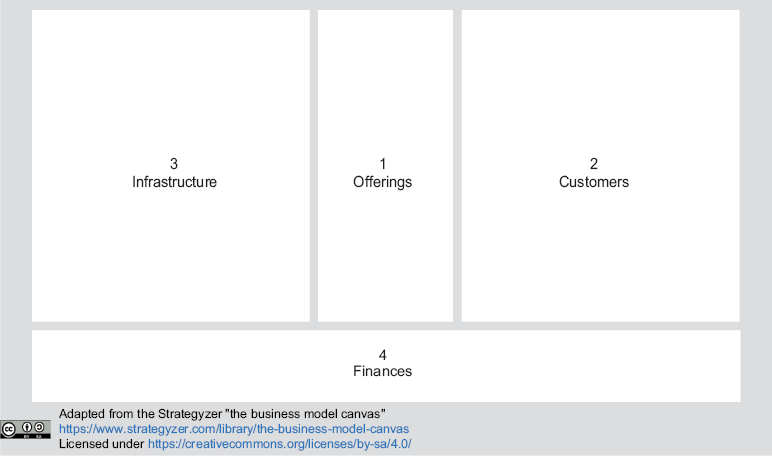
Use the canvas to examine four connected areas: offerings, customers, infrastructure, and finances. Together, they show what is offered, who receives it, what must be done, and how money flows. section 2.3.1
Work through the areas as a collaborative discovery exercise:
- Start with the value proposition: the reasons customers choose the company rather than a competitor. Give it visual emphasis because it anchors the canvas. section 2.3.1
- Describe customers, relationships, and communication channels to clarify who the company serves and how it reaches them. section 2.3.1
- Identify key activities, resources, and partners needed to deliver the offering. section 2.3.1
- Make costs and revenue streams visible, focusing on the largest costs and main sources of revenue. section 2.3.1
- Use a short legend when sticky-note colors carry meaning, then validate the resulting language and knowledge with domain experts. section 2.3.1
Aligning a ticketing modernization effort
A cinema company wants customers to buy tickets through a mobile app, but its monolithic ticketing system draws attention toward a technical rewrite. Before choosing a solution, a team can map the business model to uncover the campaign’s motivations, customer value, operational needs, and financial context. That shared context can shape priorities and later design decisions. section 2.3.1
Include development teams rather than treating the canvas as management’s artifact. Separate sessions with leadership and developers can reveal different assumptions; comparing them can expose value-proposition opportunities and create useful discussion rather than a single imposed answer. section 12.1
The canvas is one perspective among collaborative modeling tools. Use it when the question is strategic context; use complementary techniques when the team needs to examine processes, scenarios, user-story constraints, or business interactions in more detail. section 2.6

