A cell is a small, bounded region in a regular spatial grid. Surface-reconstruction algorithms divide space into cells so each region can approximate part of a curve or surface within an agreed error. Smaller cells usually improve accuracy, but increase processing and memory costs. section 11.3.1 section 11.3.2
Cells provide the local structure used by contouring algorithms:
- Marching cubes assigns a surface configuration to each cell from the inside/outside signs at its corners. section 11.3.1
- Marching squares places line segments in two-dimensional cells where neighboring grid values change sign. section 11.3.1
- Dual contouring connects points associated with neighboring cells and moves them toward positions that better fit the modeled curve. section 11.3.2
Approximating a circle
Place a circle’s signed distance function on a fine two-dimensional grid. Each cell records the signs at its corners; cells whose corners straddle the sign change receive contour segments. Refining the grid makes the polygonal approximation more accurate, while increasing the number of cells to process. section 11.3.1
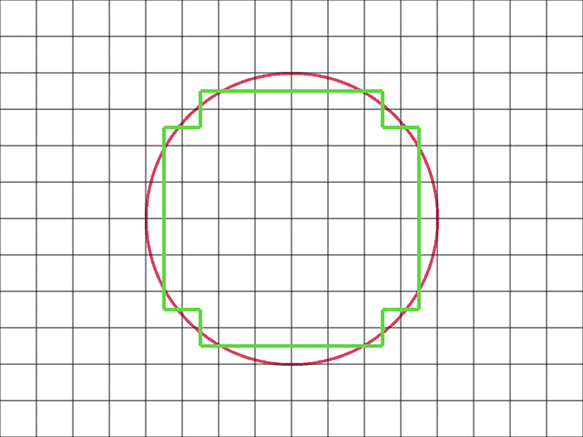
Use the figure to see how dual contouring connects neighboring cell centers rather than placing segments only along cell borders. section 11.3.2