Class imbalance occurs when one label greatly outnumbers another. In nodule detection, about 99.7% of candidates are negative, so predicting “No” every time can produce impressive accuracy without finding any nodules. section 13.10 section 14.4
Extreme imbalance affects both training and evaluation:
- The majority class can dominate the loss and hide failure on the minority class. section 13.10 section 14.4
- Overall accuracy becomes deceptive; report class-specific accuracy, precision, recall, and F1 score instead. section 14.4.2
- Balancing the training data can improve minority-class detection and reach useful results in fewer training samples. section 14.4 section 14.4.2
Why 99% negative accuracy is not enough
With 54,971 negative validation samples and 136 positive samples, a 1% negative error rate creates roughly 550 false positives—about four false positives for every actual positive. A balanced run instead identified 79.4% of positive samples while correctly classifying 98.4% of negative samples. section 14.4.2
Figure 14.16 An imbalanced dataset that roughly approximates the imbalance in our LUNA classification data
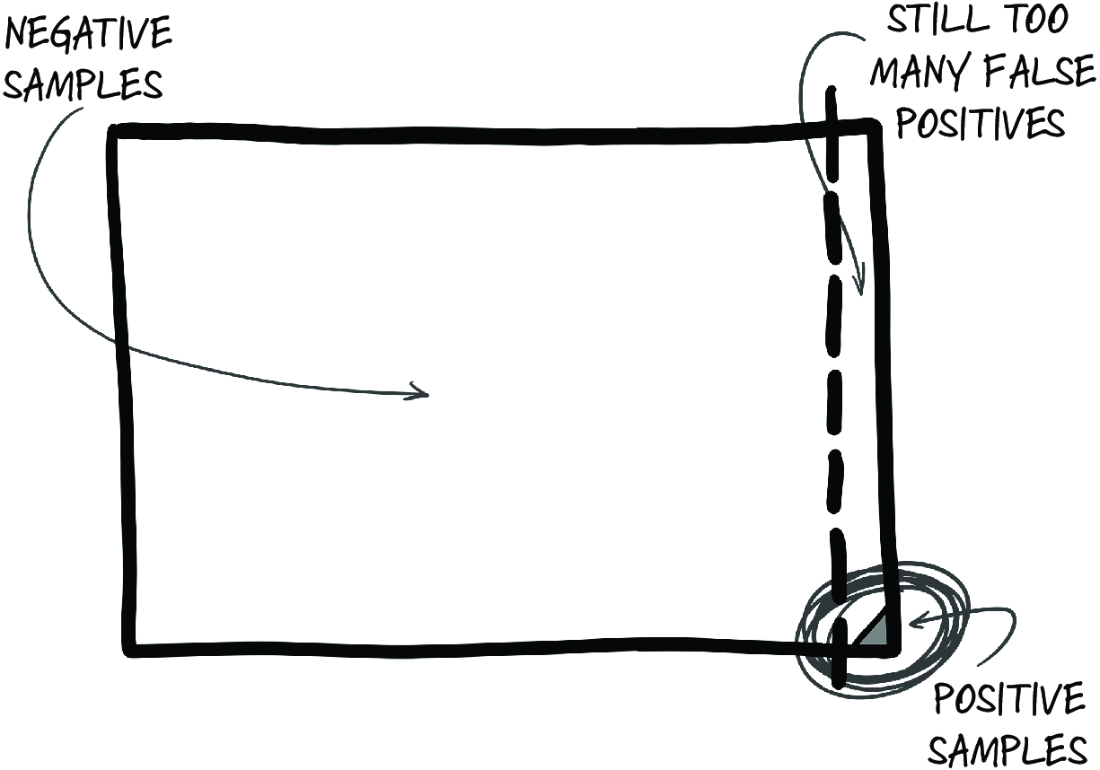
Visualizes an imbalanced dataset approximating the LUNA classification data and makes the minority class’s numerical disadvantage concrete. section 14.4










