Classless Inter-Domain Routing (CIDR) replaces rigid classful addressing with flexible network prefix lengths. CIDR notation writes the prefix length after a slash, such as /23, /26, or /28, allowing address space to fit network size more efficiently. section 11.1
An address block can be divided into smaller networks called subnets. Borrowing host bits increases the number of subnets while reducing the number of addresses available in each subnet. section 11.1 section 11.5
CIDR subnetting follows these practical rules:
- Each borrowed bit doubles the number of possible subnets and halves the addresses in each subnet. section 11.5
- A subnet’s network address is first, broadcast address is last, and usable host range lies between them. section 11.5
- FLSM creates equal-sized subnets, while VLSM creates differently sized subnets for more precise allocation. section 11.5
Example: subdividing 192.168.1.0/24
A /24 block contains 256 addresses. Changing the prefix to /25 creates two 128-address subnets; /26 creates four 64-address subnets; /27 creates eight 32-address subnets; and /28 creates sixteen 16-address subnets.
Figure 11.1 The 192.168.1.0/24 address block (network) divided into smaller subnets. With a /24 prefix length, it is one subnet of 256 addresses. Using a /25 prefix length allows the block to be divided into two subnets of 128 addresses each. /26 allows for 4 subnets of 64 addresses each. /27 allows for 8 subnets of 32 addresses each. /28 allows for 16 subnets of 16 addresses each.
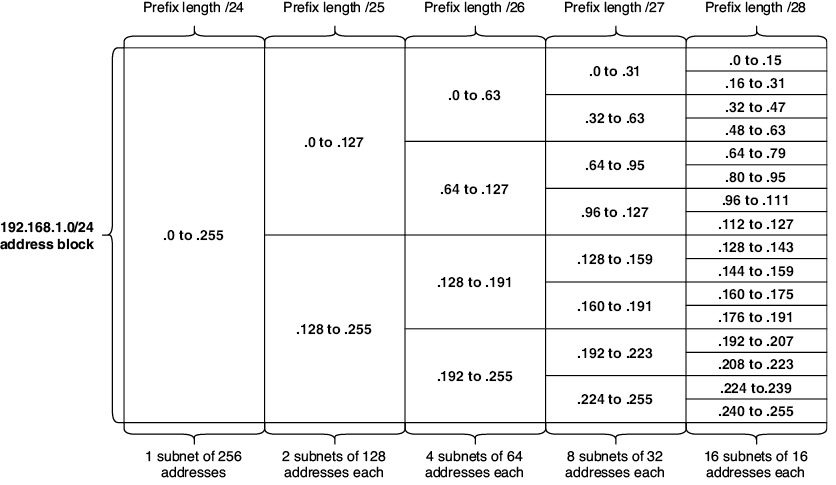
Compare how increasing the prefix length divides one /24 address block into progressively smaller subnets. section 11.1




