CLIP is a multimodal Transformer that connects images and natural-language descriptions. Separate image and text encoders project both inputs into a shared embedding space, making matching visual and textual content comparable. section 15.0 section 15.5.1
Unlike models that depend on explicit image labels, CLIP learns from large collections of image–description pairs. Its contrastive objective increases similarity for matching pairs and decreases similarity for mismatched pairs. section 15.5.1
A CLIP training pass follows these ideas:
- Preprocess images to a common shape and tokenize their descriptions. section 15.5.1
- Encode each image with a Vision Transformer and each description with a Transformer-based language model. section 15.0
- Project both modalities into D-dimensional embeddings that can be compared. section 15.5.1
- For a batch of N pairs, maximize matching similarities on the diagonal and minimize nonmatching similarities off the diagonal. section 15.5.1
Figure 15.8 How OpenAI’s CLIP model is trained. A large-scale training dataset of text–image pairs is collected. The text encoder of the model compresses the text description into a D-value text embedding. The image encoder converts the corresponding image into an image embedding also with D values. During training, a batch of N text–image pairs are converted to N text embeddings and N image embeddings. CLIP uses a contrastive learning approach to maximize the similarity between paired embeddings (the sum of diagonal values in the figure) while minimizing the similarity between embeddings from nonmatching text–image pairs (the sum of off-diagonal values in the figure).
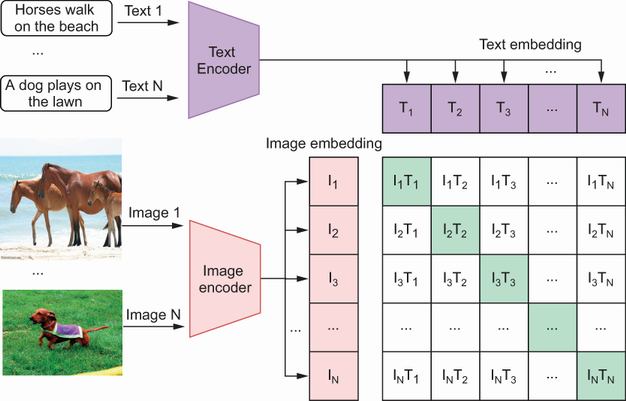
The training diagram makes the dual encoders, shared embedding dimensions, and diagonal-versus-off-diagonal contrastive objective concrete. section 15.5.1
CLIP also supplies multimodal understanding for text-to-image systems. In DALL-E 2, text becomes an embedding, CLIP produces a prior representing an image in latent space, and a diffusion process uses the resulting conditioning information to denoise random noise into an image. section 15.5 section 15.5.1
From prompt to generated image
The prompt “an astronaut in a space suit riding a unicorn” can drive DALL-E 2 image generation. A Python call selects the model, prompt, size, quality, and number of outputs, then returns a temporary image URL. section 15.5.2



