For a recommender, coverage measures the breadth of users served and catalog items surfaced. It complements precision and ranking metrics: a model can recommend relevant items near the top while repeatedly showing the same popular items to everyone. section 4.6.4
Check coverage from two directions:
- User coverage: break down performance, such as hit rate, by user activity level. A gap between power users and cold-start users shows who benefits from personalization and who may receive generic fallbacks. section 4.6.4
- Item coverage: measure the fraction of the catalog that appears in anyone’s recommendations. Low coverage can signal popularity bias and an invisible long tail. section 4.6.4
A high-ranking model with a narrow catalog
An ALS model recommends only 2.6% of available items, and more than half of those recommended items come from the most popular quartile. Precision or NDCG alone would not reveal how little of the catalog receives exposure. section 4.6.4
Figure 4.18 ALS recommends only a small percentage of available items.
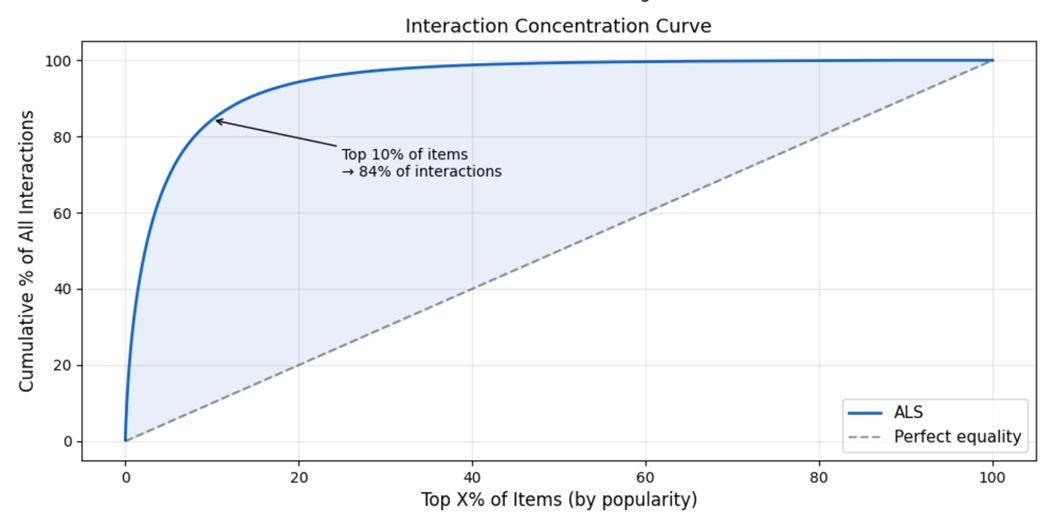
The figure makes the small share of available items recommended by ALS visible. section 4.6.4
Calculate coverage on the final recommendations users see, then inspect it alongside stage-specific results. If coverage falls, check whether retrieval supplies varied candidates before changing the scorer or re-ranker. Compare the result with a popularity baseline and the current model. A coverage loss may justify a re-ranking constraint, but whether that trade-off is worthwhile depends on the product; offline metrics inform the decision rather than settle it. section 4.6.5 section 4.8





















