liveBook · Manning

Code coverage

As explained in Build AI Drug Discovery Pipelines

Coverage is a tree-ensemble feature-importance measure based on the average number of samples affected by splits using a feature.

Coverage is an XGBoost feature-importance measure: it reports the average number of samples affected by splits that use a feature. In a molecular-binding classifier, it helps show which descriptors influence predictions across the dataset. section 6.4.2

Coverage gives a global view of ensemble behavior. It complements gain, which measures split improvement, and frequency, which counts feature uses. It does not explain why a particular compound received its prediction; that requires local interpretation. section 6.4.2

Molecular descriptor interpretation

After retraining an XGBoost model on all training data, compare coverage for molecular descriptors alongside gain and frequency to interpret RNA-binding versus protein-binding activity. section 6.4.2

Figure 6.14 Feature importance of our XGBoost model across gain, coverage, and frequency metrics.
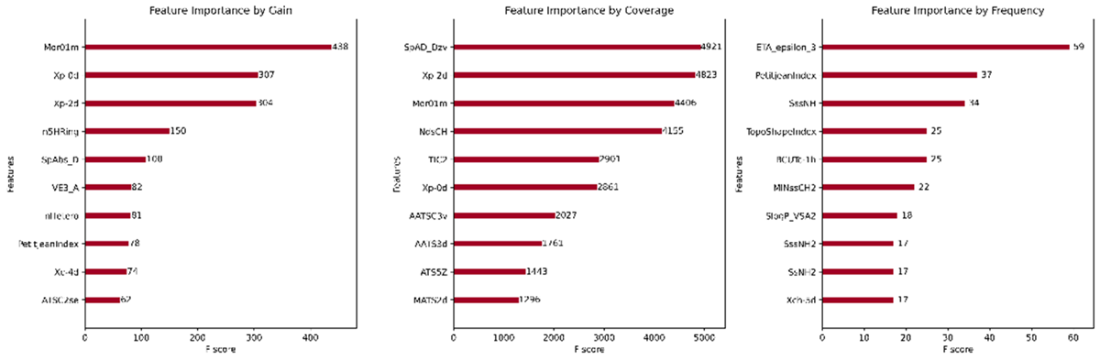
Compare coverage with gain and frequency in the feature-importance plot. section 6.4.2


How Build AI Drug Discovery Pipelines covers it

How deep it goes
Defines affected samples and contrasts coverage with gain and frequency, but stops short of local per-compound interpretation.
Examples
Uses molecular descriptors and a three-metric XGBoost feature-importance plot for RNA-versus-protein binding.
What you can do after
Evaluate global descriptor influence with coverage and recognize when single-compound reasoning requires local interpretation.
How it connects
Connects coverage to XGBoost, feature importance, gain, frequency, molecular descriptors, and local interpretation.

Also explained in

Compare how 22 books explain code coverage →

Related concepts

This explainer was generated by Manning's knowledge graph from the text of Build AI Drug Discovery Pipelines. The section links point to the parts of the book it draws on.



















