A cognitive function test asks someone to remember information, transcribe it, calculate, solve a puzzle, or perform a similar mental task. Remembering a password and copying a code from one device to another both qualify. These tasks can become barriers when someone cannot reliably recall or transfer the information. The task need not be removed if a usable alternative method or supporting mechanism is available. section 7.3.1 section 7.6
For identity and account tasks, reduce the mental work rather than asking users to overcome it:
- Allow password managers to generate and fill passwords. They reduce the need to invent, remember, and type credentials, while supporting unique passwords. section 7.3.1
- Let users paste a one-time code instead of manually transcribing it. In two-factor authentication, consider a delivery channel accessible on the same device. section 7.3.1 section 7.6
- Offer a way to sign in without a memory or transcription task, such as a magic link or passkey. For a second factor, provide at least one method that does not rely on a cognitive function test. section 7.3.2 section 7.6
A code split across six fields
A user receives one code but is asked to enter its digits into six separate fields. That change of format creates a barrier unless the user can paste the entire code into the first field and have the remaining fields populate correctly. section 7.3.1
Figure 7.2 This image shows a situation where a code presented to the user as one value is requested back as six different digits over six input fields, changing its original format. This is an accessibility barrier unless the entire code can still be pasted into the first field and the remaining fields populated correctly.
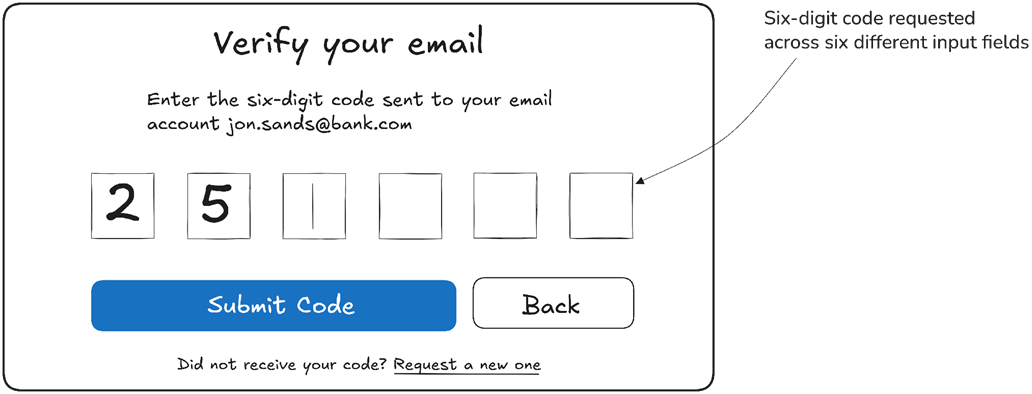
The figure contrasts a code presented as one value with an interface that demands six separate entries. section 7.3.1
NOTE: An audio CAPTCHA is not necessarily an accessible alternative to a visual one. If authentication still requires the user to transcribe what they hear, it remains a cognitive function test. Likewise, avoid making biometrics the sole way through a security process: users may not have the required ability or technology. Ask whether someone can complete the task without remembering, deciphering, or manually transferring information. section 7.5 section 7.3.2