Suppose side-quest engagement affects in-game purchases, and an analyst wants to estimate that effect. Total inventory may look like a useful predictor, but it is caused by both purchases and items won. In the causal graph, it is a collider. Adding it to an adjustment set can introduce collider bias rather than improve the estimate. section 11.2 section 11.4.1
A collider is a node where arrows on a path converge: X → M ← Y. Unlike a chain, X → M → Y, or a common cause, X ← M → Y, this path is blocked by default. Conditioning on M—or on a descendant of M—can open it. Whether two variables are d-separated depends on every path between them, not just this one. section 4.2.1 section 4.2.2
Wet grass
A sprinkler and rain can each make grass wet. Assume sprinkler use and rain are independent: knowing the sprinkler is off does not, by itself, tell you whether it rained. Once you know the grass is wet, however, learning that the sprinkler is off makes rain more plausible. Conditioning on their shared effect creates dependence between its causes. section 4.1.1
Figure 4.12 This path from u to v is d-separated by default because it contains a collider m. The collider is analogous to an open circuit. Blocking on m or any of its descendants d-connects the path and figuratively closes the circuit.
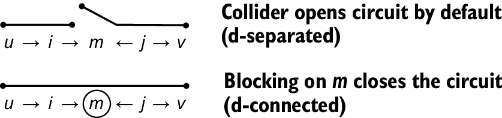
Compare the default blocked collider path with the opened path after conditioning on the collider or a descendant. section 4.2.1
Check a proposed adjustment set against the whole graph. A node can block one path yet act as a collider on another: conditioning on M blocks U ← M → V but opens U ← I → M ← J → V. Blocking the newly opened path also requires I or J, yielding minimal d-separating sets {I, M} or {J, M} in this example. Controlling for every available covariate is therefore not a safe default for causal effect estimation. section 4.2.2 section 11.4.1
Colliders also help orient a causal graph. If two variables appear independent but become dependent when conditioning on a third, that pattern can support arrows into the third variable. Such conclusions rely on the graph’s causal and statistical assumptions; dependence alone generally does not determine an edge’s direction. section 4.6.3

