A collider is a variable with two arrows pointing into it: X → Z ← Y. X and Y are both causes of Z. Unlike a confounder or mediator, Z does not create a causal route from X to Y; in the three-node collider case, only their direct path is causal. section 6.1.2 section 7.1.4
The practical risk appears when an analysis selects, groups, or adjusts for the collider. Conditioning on Z can create a correlation between its parents, or change one already present. This can make an association inside a selected group look different from the association in the full population. section 7.1.4
Acceptance can reverse an association
GPA and SAT scores can be positively correlated overall, while restricting attention to students accepted by a university can make their correlation negative. Qualification is a collider because both GPA and SAT contribute to it; analyzing only accepted students conditions on that collider. section 7.1.4
Figure 7.11 Student university acceptance DAG, based on GPA and SAT results. Qualification is a collider. Conditioning on a collider can change the correlation between the collider’s parents.
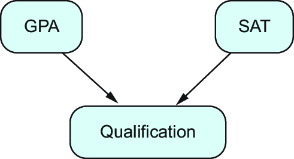
Use the acceptance DAG to trace the two arrows into Qualification, then ask how restricting the data to accepted students changes the GPA–SAT comparison. section 7.1.4
In a treatment trial, Side Effects can be a collider when both Treatment and Recovery affect it. To estimate the modeled effect of Treatment on Recovery, use a regression of Recovery on Treatment rather than adding Side Effects as an adjustment variable. This differs from confounder adjustment, where including the common cause is required. section 6.1.2
The mechanism can be checked with synthetic data: generate independent X and Y, let both affect Z, then compare their overall correlation with correlations within Z = 1 and Z = 0 groups. Conditioning creates correlations that were absent before selection. section 7.1.4
When classifying a third variable Z for an X-to-Y causal question, distinguish these patterns:
- Confounder: Z causes both X and Y; adjust for Z to estimate the modeled effect. section 6.1.2
- Mediator: X causes Z, which causes Y; adjusting for Z targets a direct effect, while omitting it targets the total effect. section 6.1.2
- Collider: X and Y cause Z; do not add Z when estimating the modeled X-to-Y effect. section 6.1.2

